Three puppies sat shoulder to shoulder beneath the trees, their small paws planted among fallen leaves. Behind them, the curved rim of an old concrete well rose from the forest floor, its surface softened by moss. Gray daylight filtered through the branches and barely reached the ground where they huddled.
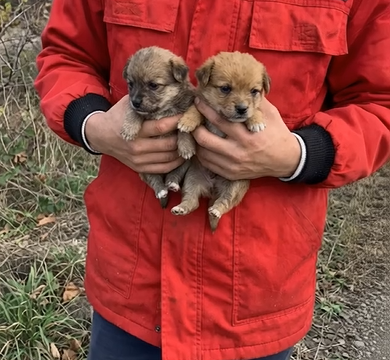
One puppy was grayish brown with a pale chest. Another was white and tan, with a white blaze marking her face. The third had a golden coat. Dust dulled their fur, and their thin bodies leaned together as they tried to remain upright on the cold earth.
Their front legs were braced beneath them, while their hind legs folded close and trembled. Each puppy held her head low, tilted slightly to one side. Even sitting seemed tiring. When they adjusted their positions, their paws disturbed the leaves and their shoulders pressed more closely against one another.
No mother appeared beside them. There was no food visible nearby, no blanket beneath their bodies, and no person tending to them in the scene. They looked in need of care, though their appearance could not tell us exactly how long they had been there or how they had arrived.
The woods offered little comfort. Dark soil lay between patches of tangled weeds, and broken branches rested among the brown leaves. Slender trunks rose into the dim canopy. Beyond the well, thick undergrowth faded into shadow, making the clearing feel separate from any place where help might be found.
The puppies shook continuously. Trembling moved through their shoulders and down into their paws, rippling across the little row. Their chests rose and fell with breathing that sounded strained and wet. Staying close provided contact, but it did not appear to bring them comfortable rest.
A soft whimpering carried through the clearing. Every so often, one puppy gave a higher cry that faded before the quieter sounds returned. Leaves crackled when their paws moved, and a faint breeze stirred the branches overhead. No nearby voice answered the small sounds coming from the ground.
It is difficult to see young animals so still. We expect puppies to investigate everything, stumble through games, and sleep peacefully after meals. These three seemed to be using their energy simply to hold their positions. Their lowered heads and shaking legs made their vulnerability clear.
Then they began to look up.
Slowly, the puppies lifted their faces toward the camera. Their dark eyes glistened as they blinked, and moisture traced their small muzzles. For a moment, their individual markings became clearer in the dim light: the pale chest, the white blaze, the golden fur.
Their heads lowered again. After a pause, they raised them once more, their paws shifting weakly among the leaves. The effort seemed considerable for such a small movement. They remained beside one another, still trembling, with the old well behind them and the forest stretching away.
Anyone watching might feel a plea in those looks. We imagine them asking for warmth or for someone to stay. Those feelings reflect our concern, but they cannot tell us precisely what the puppies understood. Their visible discomfort already gave enough reason to respond with care.
Looking closely also meant recognizing three separate lives within the huddle. Each puppy had her own needs, even when the movement of the group drew our attention first. The quietest one mattered as much as the one who lifted her head. None needed to do anything remarkable to deserve help.
For many readers, the sight brings memories of a puppy once welcomed into their home. We remember preparing bedding, checking whether a little body was comfortable, and listening for unfamiliar cries at night. Those ordinary acts show how much young animals depend on consistent attention.
These puppies deserved that same watchfulness. Their weakness and difficult breathing called for appropriate assessment. They needed a protected environment, suitable nourishment, and veterinary care suited to their condition. A blanket or gentle voice could offer comfort, but their needs extended beyond one reassuring moment.
Their closeness remained touching. Each leaned into the others, sharing contact on ground that offered little softness. We can appreciate that bond without expecting it to be enough. Companionship among siblings cannot replace the dependable care of people able to recognize and address their needs.
The account does not establish what happened after the puppies lifted their heads. It gives no confirmed rescue, recovery, or home for any of the three. We can hope they reached safety without presenting those hopes as events. Their situation deserves concern even while its ending remains unknown.
Finding vulnerable animals in an isolated place can leave a person uncertain about what to do next. An accurate location and a clear description of their number and visible condition can help a rescue organization or animal control service understand the situation. Appropriate guidance can support a careful response.
Not everyone can take in a litter, but there are other ways to contribute. Making a call, supporting a foster caregiver, or providing supplies requested by a shelter can help connect concern with practical care. Small contributions matter when they become part of something dependable.
Remember the three faces beneath the branches and the paws shifting beside that mossy well. These puppies deserved somewhere safe to rest and people attentive to their needs. May their story remind us to listen carefully in overlooked places and take a thoughtful step when a quiet cry reveals an animal who cannot manage alone without help.