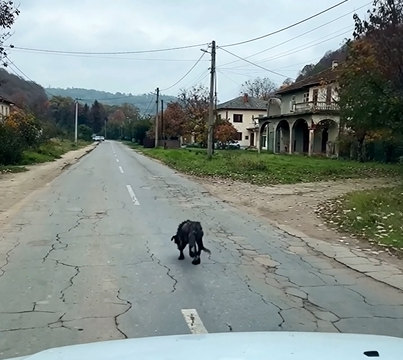
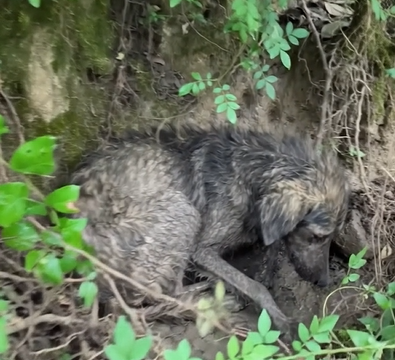
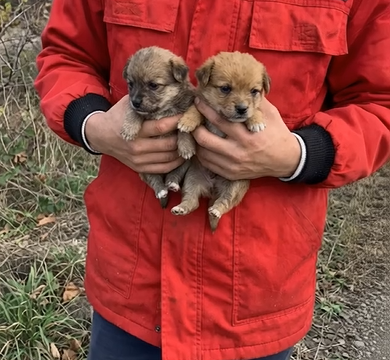
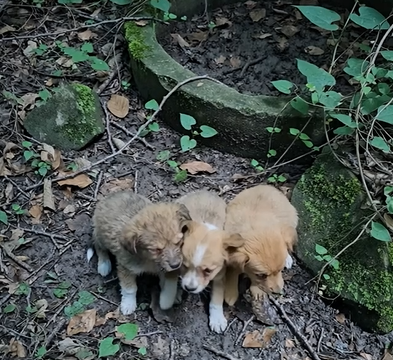
Five tiny puppies pressed against their mother’s legs beside a stretch of cracked country asphalt. Their coats were black, brown, and cream, small patches of color beneath her dusty white body. Around them, loose gravel met flattened grass, and bare trees faded into the pale afternoon sky.
The mother stood with her head lowered and her tail hanging still. Her coat was matted in places, and the outlines of her ribs and hips showed beneath it. She braced her thin legs against the ground, shifting slightly whenever her balance seemed uncertain. Standing appeared to take considerable effort.
Her puppies stayed close enough to touch her and one another. Their little bodies formed an uneven cluster around her paws, leaning inward as they trembled. She remained among them, the familiar presence they gathered around in a place without any visible comfort beyond their closeness.
No food or clean water was visible nearby. There was no blanket spread across the gravel, no sheltered resting place, and no caregiver beside the family. They looked exhausted, although the scene could not tell us how long they had been outside or where they had traveled before this moment.
The mother’s shoulders shook, and the trembling continued down through her legs. Her narrow chest rose and fell with breathing that sounded wet and strained. The puppies quivered beside her, their small movements overlapping until the whole family seemed to shift together against the cold ground.
A low whimper came from the mother. Now and then, a higher cry interrupted it before fading again. Her puppies added faint squeaks around her feet. Beyond those sounds were the scrape of paws against gravel and the rustle of brown leaves moving through the roadside brush.
It was an ordinary road in every other way. Worn pavement stretched into the distance. Weeds grew along its edge, and dry leaves gathered where the breeze left them. Nothing announced that a family needed help there except the animals themselves, standing together beneath the muted sky.
Then the mother began to raise her head.
Slowly, she turned toward the camera. Her dark eyes glistened as she blinked, and moisture marked her muzzle. One by one, the puppies turned their faces too. For a moment, their different markings became clearer as they looked toward the person nearby.
Their heads lowered again. After a pause, they lifted them once more, making small adjustments with their paws. The mother’s legs wavered, and the puppies shifted against the uneven surface. They remained together, but their continued trembling made clear that closeness alone was not enough.
Anyone watching might feel an appeal in those faces. We imagine them asking for food, shelter, or someone willing to stay. Those feelings come from recognizing their vulnerability. We cannot know precisely what they understood about the camera, but their condition already gave ample reason for concern.
The mother’s place within the group was especially moving. She was the body her puppies leaned against, the presence they kept near while their own legs shook. Her continued closeness mattered, even as her weakness showed that she needed support as urgently as the little ones around her.
It is tempting to focus entirely on the puppies because they are so small. Yet helping this family meant attending to all six animals. The mother deserved care in her own right, as well as support in meeting the demands of having young puppies beside her.
For many readers, the scene may recall a difficult season spent caring for someone else. We remember being tired and still needed, or watching a parent continue when resources were scarce. Those memories can deepen our tenderness toward this dog without telling us exactly what she was experiencing.
We may also remember the dependable care our own dogs received: a clean sleeping place, fresh water, suitable meals, and attention when something changed. Such routines can seem ordinary until we see animals without them. Then we recognize how much comfort and security those daily acts provide.
This family needed that dependability. Their weakness and difficult breathing called for appropriate assessment, while their surroundings offered little protection. Veterinary attention, suitable nourishment, and a safe environment belonged within a thoughtful response. A gentle voice could reassure them, but their needs extended beyond a single kind moment.
The account does not establish what happened afterward. It does not confirm that someone carried them away, arranged treatment, or found them homes. We can hope for those outcomes without presenting them as facts. Their condition on the roadside remains important even while the ending is unknown.
When animals are found near a road, stopping safely and noting the location can help connect them with assistance. Clear information about their number, visible condition, and surroundings can be useful to a rescue organization or animal control service. Appropriate guidance helps shape a response suited to the situation.
Not everyone can bring a mother and five puppies home. Someone can still make a call, seek assistance, or support people equipped to provide care. Helping often involves several people, each contributing something useful, rather than one person having to meet every need alone.
Remember the cream-white mother standing above five small faces, her paws adjusting against the gravel while they pressed close. She deserved relief, and her puppies deserved room to grow in safety. May their story encourage us to notice quiet distress and take a thoughtful step toward helping when a vulnerable family comes into view.
Every life matters.