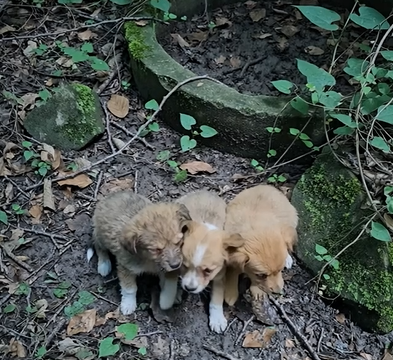
Two pairs of white-tipped paws rested among loose gravel and brittle grass. Above them, a grayish brown puppy and a golden tan puppy lay pressed together, their small legs tangled beneath dusty coats. The roadside was quiet, with brown leaves shifting in the breeze and pale daylight spreading across the ground.
Their heads rested low, tilted toward one another. Their thin tails were tucked close, and their bodies formed a little huddle against the hard surface. From farther away, they might have seemed like two small shapes in the grass. Looking closer revealed the trembling that passed through both of them.
No mother was visible nearby. There was no food or water bowl beside them, no blanket underneath, and no box providing shelter from the wind. Whatever had brought them to that spot, they appeared to have little immediate comfort beyond the contact of each other’s bodies.
Their condition raised questions about how long they had been outside, but the scene could not answer them. Dusty fur and weakness do not reveal a complete history. We could not know who had last cared for them. We could recognize that they needed attention now.
The shaking moved through their narrow shoulders and down into their paws. One puppy trembled against the other, making the whole huddle shift. Their little chests rose and fell with breathing that sounded wet and strained. Even lying still appeared uncomfortable, with no soft place for their bodies to settle.
A low whimpering continued from between them. Occasionally, one gave a higher cry that faded before the softer sounds returned. Around those cries came the rustle of dry grass and leaves. When their paws adjusted against the ground, gravel moved beneath them with a faint scraping sound.
It was difficult to see puppies so young and quiet. We usually imagine curious noses, clumsy steps, and deep sleep after a satisfying meal. These two seemed to be using their energy simply to remain close. Their small movements drew attention to how little strength they appeared to have available.
Then they began to lift their heads.
Slowly, both puppies turned toward the camera. Their dark eyes glistened as they blinked, and moisture traced their small muzzles. For a moment, their faces rose above the huddle, bringing the different colors of their coats into clearer view against the muted roadside.
Their heads lowered again. After a pause, they raised them once more, their white paws moving weakly against one another. They remained close, still trembling. The effort involved in that small action made it hard to look away from their condition.
Anyone watching might feel a plea in those faces. We imagine them asking to be carried somewhere protected, where the ground would be soft and a person would remain nearby. Those feelings reflect our concern. We cannot know precisely what the puppies understood, but their discomfort already warranted care.
Their closeness was touching. Each puppy leaned against the other, sharing contact in an exposed place. Yet that contact could not replace the support young animals need. They deserved a safe environment, suitable nourishment, and careful assessment of the weakness and difficult breathing described here.
The camera remained low, showing the puppies at their own level. From that perspective, the gravel looked rough beside their delicate paws, and the open roadside seemed large around their small bodies. The view made their vulnerability clear, but being recorded could not meet their needs by itself.
For many readers, the scene brings memories of a dog once welcomed into the family. We remember checking a sleeping puppy, making sure bedding was comfortable, or listening for movement during the night. Such ordinary acts remind us how much security comes from consistent attention.
These puppies deserved the same watchfulness. Their needs did not depend on someone knowing their names or understanding their past. Nor did they need to keep lifting their heads to prove they were worth helping. An animal too tired to respond would deserve exactly the same concern.
There is comfort in imagining a different setting for them: clean bedding, protection from the weather, and people equipped to provide appropriate care. We can hope for that future while recognizing that the account does not confirm a rescue, treatment, recovery, or home for either puppy.
That uncertainty does not make the moment less important. Two vulnerable animals were described lying on an exposed roadside, with signs of distress that deserved attention. Their story asks us to take those needs seriously without claiming knowledge of events beyond what has been shared.
When animals are found near a road, stopping safely and identifying the location can help connect them with assistance. A clear description of their number and visible condition gives a rescue organization or animal control service useful information. Appropriate guidance can support a thoughtful response.
Not everyone can take two puppies home or provide everything they require. There are still ways to help, including making a call, supporting foster caregivers, or supplying items requested by a shelter. Concern becomes useful when it contributes to dependable care rather than ending with a passing feeling.
Remember the grayish brown puppy and the golden one, their white paws shifting among stones and leaves. They deserved somewhere comfortable to rest and people attentive to their changing needs. May their story encourage us to notice quiet distress, seek appropriate help, and remember that even a small life has needs too important to overlook.
Both deserved warmth and safety.