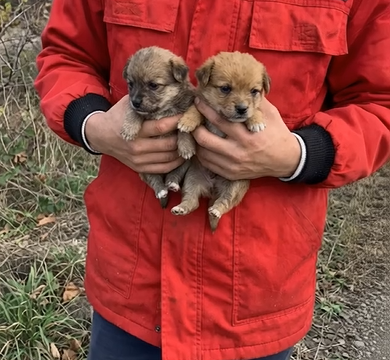
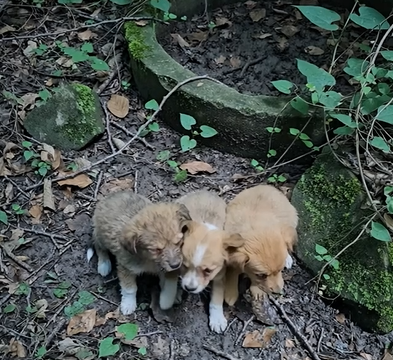
A thin paw reached up the wet concrete, searching for something solid to hold. The little golden dog stretched toward the light above her, but the wall offered no foothold. Her claws slipped against moss and damp stone, leaving her still at the bottom of the old well.
Around its opening, green moss, weeds, and fallen leaves blended into the forest floor. Someone walking nearby might have noticed only branches and undergrowth. Beneath that ordinary woodland surface was a dark shaft, and inside it stood an animal who could not climb out on her own.
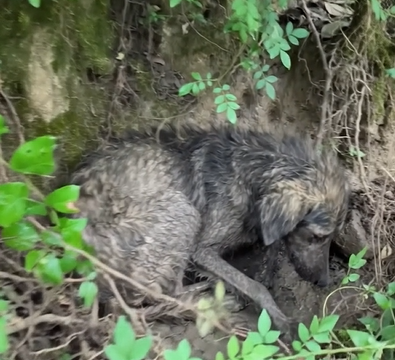
Her coat was golden tan, dulled by dirt and tangled against her thin body. Ribs showed beneath the fur. Her legs trembled as she tried to remain upright, and her tail hung low. Each effort to reach the wall appeared to demand strength she had little left to spare.
She held one front paw higher than the others, pressing it against the slippery surface. Her supporting legs wavered beneath her. Above her head, a small circle of daylight marked the opening, framed by leaves and the outlines of branches. The distance between her and that light seemed painfully large.
There was no food visible below, no clean drinking water set within reach, and no dry bedding where she could rest comfortably. Dampness marked the surrounding walls. The scene could not tell us how long she had been trapped, but her condition made the need for assistance clear.
Her narrow chest rose and fell with breathing that sounded wet and strained. Trembling moved through her shoulders and down into her paws. Even when she paused her attempts to climb, her body did not seem at ease. Standing, breathing, and reaching all appeared to require effort.
A low whimper filled the shaft. Occasionally, it rose into a higher cry that echoed against the concrete before fading. Water dripped nearby, and her claws scraped the wall when she tried again. The enclosure made those small sounds linger around her.
It is difficult to imagine being so close to open air and yet unable to reach it. The forest continued above her, with branches moving and leaves gathered around the rim. Below, the same walls surrounded every attempt she made. The place that concealed her also prevented her escape.
Then she lifted her face.
Slowly, she turned toward the camera. Her dark eyes glistened as she blinked, and moisture traced her thin muzzle. For a moment, her face was clearer beneath the tangled fur. She held her head up while the trembling continued through the legs supporting her.
Her head lowered again. After a pause, she raised it once more, and her paw moved weakly against the mossy wall. There was little distance in the movement, but its difficulty was apparent. She remained trapped beneath the opening, still making small efforts toward the space above.
Anyone watching might feel a plea in that gaze. We imagine her asking to be lifted somewhere safe, where her paws could rest on dry ground. We cannot know exactly what she expected from the nearby presence. Her circumstances already gave enough reason to seek appropriate help.
Her repeated attempts were moving, but she did not need to keep trying to deserve rescue. An animal too exhausted to raise a paw would matter just as much. Her life had value beyond the effort visible in this moment, and her safety should not depend on appearing brave.
For many readers, her face may bring a familiar companion to mind. We remember a dog waiting by the door, following us through the house, or sleeping near our chair. Knowing the comfort those animals found beside us makes this dog’s confinement especially hard to witness.
She deserved dependable care too. Her weakness and difficult breathing called for appropriate assessment, while the shaft itself presented an immediate obstacle. Getting her to safety would require people equipped to respond carefully. Once out, she would still need attention to her condition and a protected place to rest.
Finding an animal in a well is a situation where compassion and caution belong together. Entering an unfamiliar shaft or leaning over an unstable edge can put another life at risk. Contacting emergency services or rescuers trained for such situations can help bring the right assistance to the location.
Clear information matters: where the opening is, what can be seen from a safe position, and how the animal appears. The person who notices does not have to solve every part of the rescue alone. Recognizing the danger and seeking capable help can be an important contribution.
The account does not establish what happened afterward. It does not confirm that the dog was lifted out, treated, or taken home. We can hope those things followed without describing them as events. The moment at the wall remains a reason for concern, even while the ending is unknown.
Stories like hers remind us that distress can remain hidden beneath familiar surroundings. A faint cry might come from somewhere we would otherwise pass without looking. Paying attention can reveal a need, and thoughtful action can connect that need with people able to respond.
Remember the golden face beneath the circle of light and the paw searching the wet wall. She deserved relief from that confinement, care for her weakened body, and somewhere safe to rest. May her story encourage us to listen closely and seek help when an animal’s quiet voice reaches us from somewhere hidden.