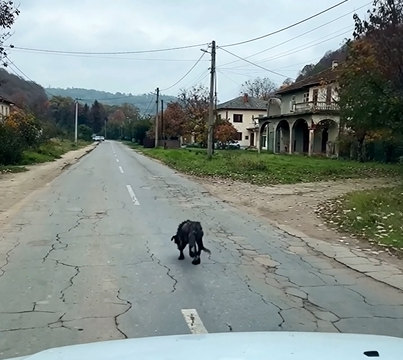
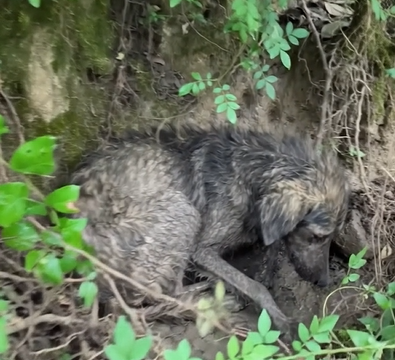
The black dog turned her head toward the woods behind her, then stood still in the damp grass. Bare branches filled the hillside, their tangled outlines dark against a pale sky. Around her paws lay fallen leaves and patches of trampled earth, with no shelter visible nearby.
Her coat was dusty and patchy, lacking the shine that careful attention can help preserve. Beneath it, the outlines of her ribs and hips were apparent. Her front legs stood stiffly beneath her shoulders, while her hind legs bent in a trembling crouch. Her tail hung low.
She seemed to be concentrating on remaining upright. When her weight shifted, her legs wavered, and she adjusted her paws against the ground. Her lowered head made the posture look more tiring. There was little ease in the way she held herself within that quiet clearing.
No house stood in view. No food or water bowl appeared beside her, and no person was tending to her in the scene. Her appearance raised questions about where she had come from and how long she had needed help. It could not provide answers to those questions.
Looking back toward the trees, she might have been responding to a sound or searching for something familiar. We cannot know what drew her attention. What we could see was a thin dog, visibly weak and uncomfortable, standing in a place that offered little protection.
The trembling continued through her shoulders and down into her paws. Her small frame shook beneath the uneven coat. Each breath moved her narrow chest with effort, and the sound was wet and strained. Faint clouds of vapor drifted from her nose into the cold air.
A low whimpering carried across the clearing. Occasionally, a higher cry broke through before fading again. It was a quiet sound within a large landscape, surrounded by the breeze and the movement of leaves. Close by, however, it gave her distress a presence that was difficult to overlook.
There is something affecting about an animal trying to stay steady on weakened legs. We recognize the effort without needing an explanation. The little movements of her paws, the lowered head, and the repeated shaking made clear that standing there was demanding more than it should.
Then she began to lift her face.
Slowly, she turned toward the camera. Her dark eyes glistened as she blinked, and moisture traced her thin muzzle. She held her head up, bringing her face into clearer view. The trembling continued beneath her while she looked toward the nearby presence.
Her head lowered once more. After a pause, she raised it again, and her legs wavered against the damp ground. Her paws moved slightly to steady her. It was an ordinary action made difficult by her condition, and that difficulty was what made the moment linger.
Anyone watching might feel a question in that gaze. We imagine her asking whether someone will stay or offer help. Those feelings are understandable, but they cannot tell us exactly what she expected. Her visible weakness already gave enough reason for a caring response.
For many readers, this scene may bring familiar memories close. We remember a dog who waited near the door, followed us through the house, or rested quietly beside us during a difficult evening. Such companionship becomes part of daily life, and its absence here feels painful.
This dog deserved dependable care whether or not anyone knew her history. Her worth did not depend on having belonged to a family, showing loyalty, or responding warmly to a stranger. She was a living animal whose discomfort mattered, with needs that could not be met by simply remaining outdoors.
The setting emphasized those needs. Damp grass lay beneath her paws, bare branches rose overhead, and the wind moved through without much obstruction. There was no dry bedding visible and no protected resting place. The clearing might have seemed ordinary until her condition drew attention to its harshness.
Her weakness and difficult breathing called for appropriate assessment. Food, clean water, protection from the weather, and veterinary care belonged within a thoughtful response. A gentle voice could offer reassurance, but lasting help would require attention to more than the emotional power of a single look.
Many people understand what it means to need support without knowing how to request it. We remember someone noticing our exhaustion or offering practical help at the right time. Those memories can deepen compassion for an animal unable to explain her circumstances, without making her experience identical to ours.
The account leaves what happened afterward unknown. It does not confirm a rescue, treatment, recovery, or home. We can hope she reached safety without turning that hope into a reported event. Her situation deserves concern even when the rest of her story has not been told.
When a vulnerable animal is found, clear information can help connect that animal with assistance. An accurate location and description of visible conditions can be useful to a rescue organization or animal control service. Seeking guidance can help people respond appropriately rather than relying on assumptions about what is needed.
Not everyone can provide all the care an exhausted dog requires. Someone can still make a call, share accurate information, or support people equipped to help. Remember this little dog among the bare trees, her paws adjusting in the grass. She deserved relief and dependable care. May her story encourage us to notice quiet distress and take a thoughtful step toward helping.