Rain gathered in the long fur around her face and dripped into the mud beneath her paws. The little gray and brown dog stood close to a closed metal gate, her head lowered toward its rusted bars. Beside her, a weathered green picket fence followed the edge of the lane.
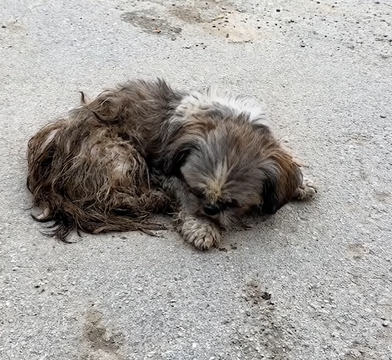
She remained in that one place while water collected along the gravel path. Her coat was soaked, its tangled strands pressed against a thin body. Beneath the wet fur, her ribs showed clearly. Her legs looked too slender for the effort of keeping her upright on the soft ground.
Her hind legs trembled in a partial crouch, and her tail hung still. Every so often, her legs wavered beneath her, forcing another small adjustment. She kept her face near the gate. Whatever drew her to that spot, she appeared reluctant or unable to move away from it.
No one stood beside her. There was no dry bedding visible, no food bowl, and no sheltered corner where she could settle. Her appearance suggested hardship, but it could not tell us how long she had been outside. The rain and mud revealed her circumstances without explaining her history.
Perhaps that is part of what makes the scene so difficult. A closed gate is an ordinary thing, something we pass without thinking. Here, it stood just beyond a wet nose and a pair of trembling paws. The distance between exposure and shelter seemed small, yet no opening appeared.
Her whole body shook. The trembling traveled from her shoulders down through her legs, scattering drops of water from her fur. Her narrow chest rose and fell with breathing that sounded strained and wet. Even remaining still demanded effort from a body that seemed to have little strength left.
A soft whimper continued beneath the rain. Now and then, a higher cry broke through before fading again. The sound mingled with water striking the leaves and gathering in puddles. It was quiet enough to miss from farther away, but close by it made her discomfort painfully apparent.
Wet grass bordered the path. Vines tangled through the fence, and dark trees faded into the distance under the gray sky. Wind moved through the lane while the rain continued. The setting offered plenty of movement, but none of the reassuring activity of someone coming out to care for her.
Then she turned her head.
Slowly, she lifted her face toward the camera. Her dark eyes glistened as she blinked, and water traced her thin muzzle. With rain soaking her fur, it was impossible to know the source of every drop. What remained unmistakable was the effort of looking up.
For a moment, she held that position. Her ears and tangled facial hair framed a tired expression. It was easy to imagine her asking for the gate to open, or for the person nearby to stay. Those are understandable feelings in someone witnessing an animal so visibly in need.
Her head sank again. After a pause, she raised it once more, shifting her weight as her paws pressed deeper into the mud. Her legs slipped slightly, then steadied. She remained beside the bars, with rain falling around her and dripping from the coat clinging to her body.
We cannot know precisely what she expected from that gate. The scene does not establish whether the property was familiar or whether anyone behind it knew her. We do not need those answers to recognize her vulnerability. She deserved help regardless of why she had stopped there.
Anyone who has lived with a dog may remember a familiar face waiting near a door. We remember the sound of paws when we came home, the small greeting after an ordinary errand, the companion who seemed content simply to have us nearby. This dog’s waiting brings those memories close.
It also reminds us that care is made of dependable, ordinary things. A protected place to sleep. Suitable food and clean water. Attention when something changes. For this dog, her weakness and difficult breathing meant that appropriate veterinary care mattered alongside the warmth and reassurance we instinctively wanted to offer.
A towel and a gentle voice would be welcome comforts, but her needs extended beyond a single kind moment. She needed people who could respond thoughtfully to her condition and continue caring for her afterward. The responsibility would not end when her fur was dry or the rain stopped.
The account leaves what happened next unknown. It does not confirm that the gate opened, that someone carried her away, or that she recovered. We can hope for a safer future without claiming it occurred. Her condition at this moment gives enough reason for concern and compassion.
When an animal appears distressed, accurate information can help others respond. Noting the location and describing what is visible can be useful when contacting a local rescue organization or animal control service. Sometimes a person’s contribution begins with that call, connecting an overlooked animal with people able to help.
Remember the small dog beside the green fence, her wet coat heavy and her paws shifting in the mud. She deserved relief from the weather and attention to her suffering. May her story encourage us to notice distress even on familiar streets, and to turn the wish to help into a thoughtful action.
Somewhere beyond that closed gate, we hope there was a place where she could finally rest, watched over by someone who would meet her needs.