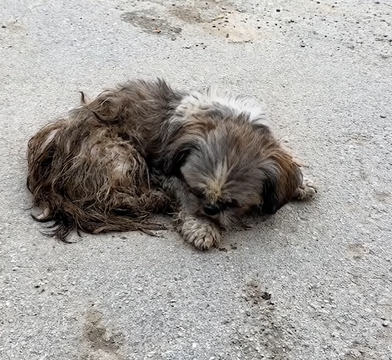
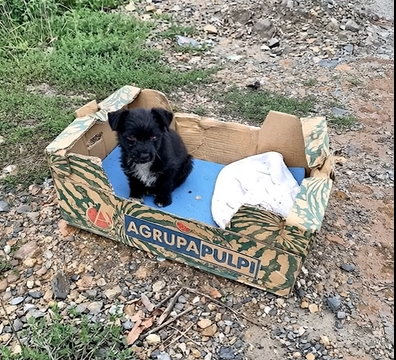
Where the pavement ended and the gravel began, three tiny puppies lay pressed together beneath a gray autumn sky. Dry leaves rested around them, caught among pale stones and flattened grass. From a passing car, their dark coats might have blended into the roadside. Up close, their trembling was impossible to miss.
One puppy was black and tan. Another had a dark brindle coat, and the third was solid black. Road dust dulled their fur. Their little legs overlapped beneath the huddle, their tails tucked close, and their heads rested low against one another. They occupied such a small space beside the empty road.
Behind them, thick bushes carried yellowing leaves. Bare trees stood farther away, fading into the pale distance. The asphalt was worn, and brittle grass marked the shoulder. There was no comfortable place for the puppies to settle, only loose ground and the warmth they could find against each other.
No mother was visible. No food or water bowl stood nearby, and no person appeared beside them. The scene suggested they needed help, but it could not establish how long they had been there or what had brought them to this spot. Their condition mattered without those answers.
The shaking passed through the whole pile. One small body trembled against the next, disturbing dusty fur and the leaves beneath them. Their chests rose and fell with breathing that sounded strained and wet. Even while lying close together, they appeared unable to rest comfortably or escape their distress.
A low whimpering continued from the huddle. Every so often, a higher cry rose above it, then faded into the quieter sounds again. Their paws moved against the stones with a faint scraping noise. Around them came the rustling of leaves and the wind moving through the roadside bushes.
Puppies usually make us think of movement: clumsy games, curious noses, and little feet following a familiar person across a room. These three were almost still. Their energy seemed devoted to remaining close and making small adjustments against one another on ground that offered little comfort.
Then the black and tan puppy began to lift her head.
Slowly, her face emerged above her siblings. Her paws shifted as she turned toward the camera, and her dark eyes glistened in the muted light. Moisture traced her little muzzle. She blinked and held her head up briefly while the trembling continued through the bodies around her.
It was a small movement, yet it drew attention to her as an individual. She had her own face, her own markings, and her own need for care. Beside her were two other puppies whose needs were just as urgent, even when their faces remained lowered or partly hidden.
Her head settled back against the others. After a moment, she raised it again, moving her paws weakly as she tried to steady herself. The effort seemed considerable for such a slight action. Watching her, it was easy to wish that a gentle voice would answer from nearby.
We may feel a plea in that look. We may imagine her asking for shelter, warmth, or someone willing to stay. Those feelings help us connect with what we see, but we cannot know exactly what she understood. Her visible weakness already gave enough reason to respond.
For many of us, a scene like this brings back memories of dogs who shared our homes. We remember a puppy sleeping near the kitchen, an old companion waiting by the door, or a familiar head resting against our knee. Those memories make unfamiliar animals feel less distant.
These three deserved the same dependable care. They deserved somewhere protected to rest, suitable nourishment, and attention to their weakness and difficult breathing. A warm blanket could offer comfort, but their needs extended beyond a single gesture. Appropriate veterinary care and ongoing supervision mattered too.
Their closeness was touching. Each puppy rested against the others, finding contact in an exposed place. That shared warmth may have helped, but it could not replace the care young animals depend on. They needed someone able to recognize their condition and connect them with assistance.
We cannot tell from this account what happened afterward. It does not confirm a rescue, recovery, or home for any of the puppies. We can hope for those outcomes without describing them as facts. Their moment beside the road deserves concern even while the rest of their story remains unknown.
When animals are found near traffic, stopping safely and providing an accurate location can be useful first steps. A local rescue organization or animal control service may be able to help assess the situation. Clear information about the animals and their condition gives responders something practical to work with.
Not everyone can bring three puppies home, and concern does not require pretending otherwise. Sometimes helping means making the call, staying at a safe distance while seeking guidance, or supporting people equipped to provide care. What matters is directing our attention toward what the animals actually need.
Remember the black and tan face lifting above the brindle and black coats. Remember the small paws shifting among pale stones and fallen leaves. These were three vulnerable lives beside an ordinary road, each deserving care. May their story encourage us to notice what is easy to miss and make room for a thoughtful response when a quiet cry reveals someone in need.
They deserved a future with soft bedding, steady care, and space to grow strong.