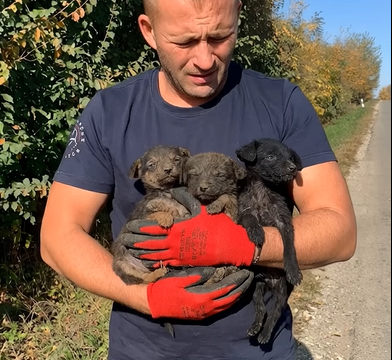
At first, the hollow in the dry grass might have looked empty. Brown stalks bent beneath a gray sky, and the wind moved through the field without anything to interrupt it. Then a small movement revealed seven puppies lying together, their bodies pressed into one another on the flattened ground.
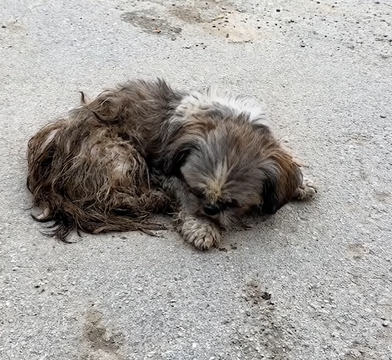
Their coats were different colors. Some were black, others black and tan, and one little puppy had grayish brown fur with white tips on her paws. Dust dulled those markings. Their legs overlapped, their tails stayed tucked close, and their lowered heads rested among the small bodies beside them.
There was no mother visible near the huddle. No blanket covered the grass, and no food or water bowl stood within sight. The surrounding field offered little protection from the weather. Whatever had brought these puppies there, the scene showed young animals without the care and security they needed.
Their appearance could not tell us how long they had been outside. We could not know who had last held them or whether someone had been searching for them. Those questions remained unanswered. Their condition, however, gave enough reason to stop and pay attention to what was happening.
All seven trembled against one another. The shaking traveled through the pile, disturbing dusty fur and the dry grass underneath. Their small chests rose and fell with breathing that sounded strained. They stayed close, but the warmth of their siblings could not provide everything their vulnerable bodies needed.
A soft whimpering came from somewhere within the huddle. At moments, one puppy gave a higher cry that briefly rose above the wind. Then the quieter sounds returned, mingling with the rustle of brittle stalks. It was a faint chorus from animals who had no other way to draw attention.
Young puppies usually bring to mind the warmth of a kitchen, a soft sleeping place, and clumsy feet following one another across the floor. Here, the ground was bare beneath the flattened grass. Their small movements seemed devoted to finding a little comfort in the bodies nearest them.
The grayish brown puppy began to stir.
Slowly, she lifted her head above her siblings. Her neck wavered as she turned toward the camera, and her white paws shifted against the others. Her dark eyes glistened as she blinked. Moisture traced her muzzle while she held her face toward the nearby presence.
For a moment, one little face stood out from the larger pile. She was an individual puppy, with her own markings, movements, and needs. Around her were six others, each just as important, even when their faces were hidden beneath a sibling or turned down toward the grass.
Her head lowered again, settling among the others. She stayed there briefly before lifting it once more. The movement was small and slow. Her paws pressed weakly against the huddle as she adjusted herself, and the trembling continued through the bodies gathered around her.
It is natural to read hope into that effort. We want to believe she recognized the possibility of help, because we want help to arrive. We cannot know exactly what she understood. We can see that the puppies needed care, whether they looked toward the camera or remained curled together.
Beyond them, tall grass leaned in the wind. Tangled weeds and scrubby bushes marked the edges of the field. A few yellowing leaves held to their branches or moved across the ground. The gray daylight softened the distance, leaving the little hollow exposed beneath an open sky.
There was no person tending the puppies in view. Yet the camera brought their presence into focus, showing a place that might otherwise have seemed unremarkable. A field is easy to pass without wondering what lies inside it. Here, looking closer revealed seven lives in need of attention.
Many of us remember moments when someone noticed we were struggling before we knew how to ask for help. A neighbor stopped by. A friend stayed longer. Someone made a practical offer when we were too tired to think clearly. Those memories can deepen our tenderness toward vulnerable animals.
These puppies needed more than tenderness alone. They needed a safe environment and care appropriate to their age and condition. Their weakness and difficult breathing called for veterinary attention. Bringing their situation to people equipped to help could turn a moment of concern into something useful for the entire litter.
The account does not establish what happened afterward. It gives no confirmed rescue, recovery, or home for any of the seven. We can hope for those things without presenting them as events that occurred. The uncertainty does not diminish the importance of what was visible in that hollow.
When we encounter animals in distress, sharing an accurate location and description with a rescue organization or shelter can help others respond. Sometimes we can offer direct support; sometimes our role is to connect the right people. Either way, paying attention becomes meaningful when it leads toward appropriate assistance.
Remember the white paws shifting among dark coats, the lowered heads, and the grass moving around seven trembling bodies. Each puppy deserved the chance to rest somewhere safe and receive attentive care. May their story encourage us to look carefully at the places we usually pass and remember that a faint sound can belong to someone whose whole world depends on being noticed.
For these little ones, a warm, protected place and someone willing to help were needs that could not wait.