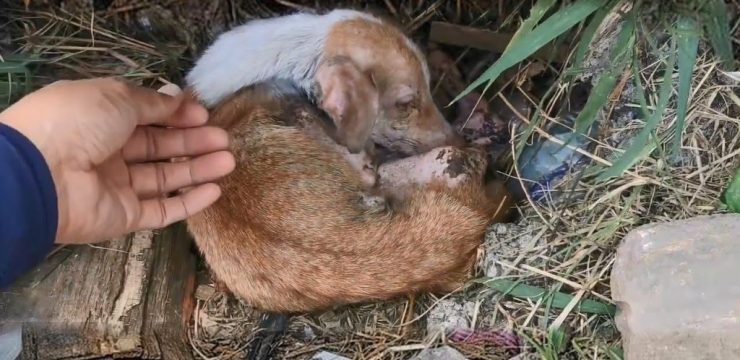
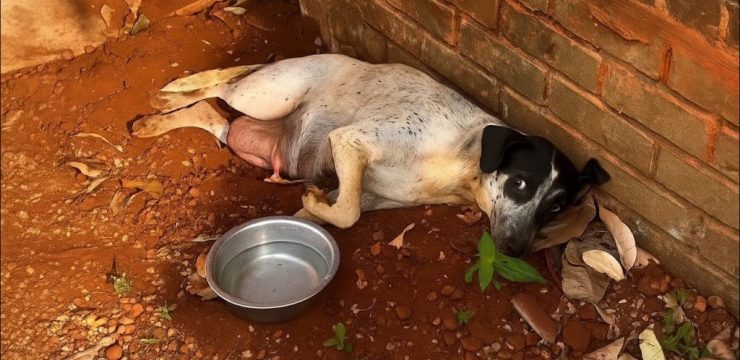
For sixteen long years, Youngji, a senior dog with soft, kind eyes and a remarkably gentle spirit, lived a life no living creature should ever have to endure. Day after day, season after season, she remained chained outside, exposed to the harshness of blazing summers and the bitter cold of winter nights. Rain soaked her fragile body, and the sun beat down relentlessly, yet there was never shelter, never comfort. She never experienced the warmth of a loving touch or the softness of a bed. Her world was painfully small, defined only by the patch of dirt beneath her feet and the cold, rusted chain that confined her.

When rescuers finally discovered Youngji, the sight before them was deeply heartbreaking. Her body was weak and frail, her belly swollen to an alarming size that made even the simplest movement difficult. Standing seemed like a burden, and every breath she took appeared labored, as though her body had been fighting a long, silent battle without relief. The severe swelling in her abdomen was caused by ascites, a condition where fluid builds up, often linked to serious heart or liver issues. The weight of that fluid pressed down on her small frame, making her legs tremble and leaving her unable to move without visible discomfort.
Despite everything, Youngji did not react with fear or aggression. There was no barking, no growling, no resistance. Instead, she looked up quietly, her eyes calm and full of a quiet understanding. It was as if she had accepted her suffering long ago, carrying it with a dignity that left everyone who saw her deeply moved.
When her former owner was questioned about her condition, the response was chilling in its indifference. He simply said, “She’s too old. She’s already lived her life.” Those words lingered in the air, heavy with disregard, as if the passing of time somehow justified years of neglect. As if age meant she no longer deserved care, compassion, or even basic dignity.
But the rescue team saw something entirely different. They saw a life that still mattered, a soul that had waited patiently for kindness. In the gentle sway of her weak tail and the way she softly leaned into their hands, there was trust—pure and unconditional. Remarkably, she seemed to place more faith in these strangers than in the humans she had known for over a decade.
At the veterinary hospital, the full extent of Youngji’s condition became clear. She was battling heartworm disease, serious heart complications, and damage to her lungs that had likely developed over many years. Her body had been enduring these illnesses silently, without treatment or relief. Veterinarians worked carefully to drain more than eight liters of fluid from her abdomen, an amount that would equal or even exceed the entire weight of some small dogs. The procedure brought her a measure of relief, allowing her to breathe a little easier and move with slightly less strain.
Even so, her recovery would not be quick or simple. Years of neglect had taken a lasting toll on her muscles and strength. Walking even a few steps required effort, and her body remained fragile. Yet for the first time in her life, she was surrounded by people who truly cared, people who refused to look away from her pain and instead chose to stand beside her.
They treated her with a tenderness she had never known. They bathed her gently, cleaning away the dirt that had covered her for so long. They spoke to her in soft, reassuring voices, offering comfort in ways she had never experienced. Warm meals were placed before her, soft blankets wrapped around her tired body, and patient hands remained close, ready to soothe and support.
They did not expect miracles. They did not demand quick progress. Their only wish was for Youngji to understand one simple truth: she was safe now, and she was loved.
One of the most touching moments came after several days of rest. With quiet determination, Youngji slowly stood on her own and took a few small steps toward the volunteers who had been caring for her. It was not a long walk, nor was it steady, but it was enough. In that gentle movement was a message stronger than words. She was still here. She was still trying.
The room fell silent, filled only with the soft hum of medical equipment and the quiet emotion of those who had come to care for her so deeply.
Youngji’s story is not an easy one to hear. It carries pain, and it reflects a reality that many animals face without a voice. Yet within that sadness lies something powerful. Her story is a testament to resilience, to the quiet strength of a spirit that refuses to be broken, even after years of hardship.
Now, in the final chapter of her life, Youngji is surrounded by comfort. She has a warm place to rest, nourishing food, and the gentle presence of people who ensure she is never alone. She can feel the grass beneath her paws without the weight of a chain holding her back. She is cared for, spoken to, and cherished in ways she had been denied for so long.
While she can never reclaim the sixteen years she lost, she has been given something just as meaningful. She now understands love. She knows that she matters, that her life holds value, and that even at the end of a long journey, something beautiful can still begin.
For anyone who has ever loved an aging pet, or wondered whether it might be too late to make a difference, Youngji’s story offers a gentle but powerful reminder. It is never too late to care. Never too late to show kindness. And never too late to give a deserving soul the peace it has always needed.
Her body may remain fragile, and her steps may still be unsteady, but her spirit shines brighter than ever. And in that quiet strength, she reminds us all of a simple, enduring truth.
Every life matters. And sometimes, those who have suffered the most are the ones who teach us the deepest meaning of love.