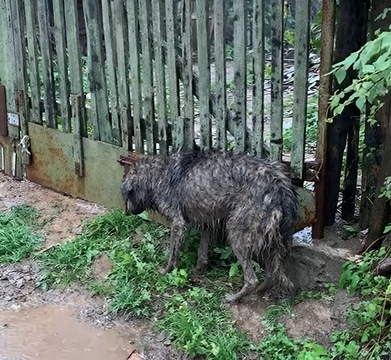
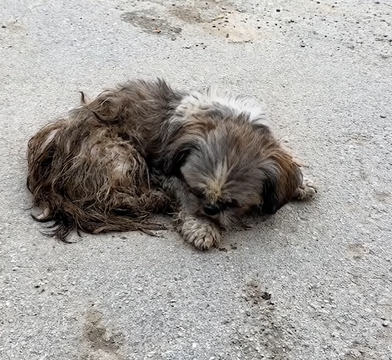
Dry yellow leaves moved across the cracked pavement while a small white dog struggled to remain standing. Behind her, a closed iron gate stood beside a weathered concrete staircase. The afternoon light was dim, and the street looked quiet. In that setting, her unsteady legs made it clear that something was wrong.
Her head was black, and dark spots scattered across her dusty white coat. She had long, slender legs, but little strength seemed left in them. Her ribs and hip bones showed faintly beneath her fur. She stood with her body lowered, her tail hanging close to the ground.
Her hind legs trembled in a partial crouch. The front ones braced against the asphalt, shifting as she tried to steady herself. She held her head down and forward, making her neck look longer and more fragile. Even without knowing her history, it was difficult to mistake that posture for comfort.
No one stood beside her. There was no bowl within sight and no blanket waiting on the pavement. The account gives no certain measure of how long she had been outside. Her appearance suggested hardship, but it could not tell us which streets she had traveled or who might have known her.
What mattered in that moment was the effort of standing.
Shaking passed through her shoulders and continued down her legs. It seemed to leave her little opportunity to settle. Her narrow chest rose and fell with breathing described as wet and strained, each movement visible beneath her thin coat. She looked in need of care far beyond a passing glance.
A soft whimpering carried through the quiet. Now and then, it rose into a brief, higher cry before fading again. The sound was faint beside the open space around her. Yet it brought the scene into focus: a vulnerable animal was having a difficult time on a street lined with closed doors.
The neighborhood held familiar details. Rust marked the staircase railings. Green bushes grew beside the gate, with orange leaves caught among their branches. The rear of a parked white van appeared nearby. Damp patches darkened the asphalt, and loose autumn leaves gathered wherever the breeze allowed them to rest.
These were things someone might pass every day without remembering. That afternoon, they surrounded a dog who could barely hold her position. The closeness of buildings and a parked vehicle made her isolation feel especially painful. Human life was evident all around her, but no helping hand appeared beside her.
Then she began to lift her head.
The movement came slowly. She turned toward the camera, her dark eyes catching the pale light as she blinked. Moisture glistened around them and traced her muzzle. For a few moments, she held her face toward the person nearby while the trembling continued through her body.
It is natural to feel an appeal in that gaze. We imagine warmth, shelter, and someone speaking gently because those are comforts we want for her. We cannot know precisely what she expected from the camera. Her need was clear enough without assigning a thought to every movement.
Her head lowered once more. After a pause, she raised it again, and her legs wavered beneath the effort. Her paws shifted on the rough surface as she tried to remain balanced. It was a small action, but one that showed how difficult an ordinary movement had become.
For people who have loved dogs through many seasons, a face like hers brings memories close. We remember the companion waiting by the door after work or sleeping near our chair on a winter evening. We remember how familiar footsteps could bring a sleepy head up and a tail into motion.
The dog on this street deserved the same dependable care we wanted for those companions. She deserved a resting place where she would not have to struggle for balance on pavement. She deserved attention to her condition, protection from the weather, and people who would take responsibility for her wellbeing.
We do not have to know whether she once belonged to someone to recognize that responsibility. Nor should her claim to kindness depend on remaining upright or looking toward a person. An animal too exhausted to respond would deserve the same concern. Her vulnerability was reason enough to help.
The story leaves what happened afterward uncertain. It does not establish a treatment plan, a recovery, or a home waiting for her. Those are outcomes we can hope for, but the moment before us remains one of need. Telling it honestly gives that need its proper weight.
When a dog appears this weak, connecting her with appropriate help matters. A clear location and an accurate description can give a local rescue organization or shelter useful information. Veterinary attention and a safe place to rest belong alongside the gentle reassurance so many viewers instinctively want to offer.
Not everyone can bring an animal home. There are still ways to respond, from reporting a concern to supporting those able to provide care. The important question is what might help the animal in front of us, given her condition and the circumstances around her.
Remember the white dog with the black head standing beneath those rusted railings. Remember her paws adjusting against the asphalt and the leaves moving past. She deserved more than a quiet street and a closed gate. May seeing her encourage us to notice distress nearby and turn that attention into something useful, patient, and kind.