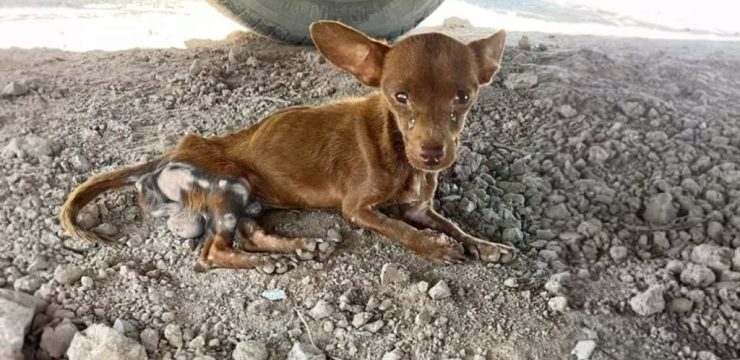
When rescuers first met Atrey, the sight before them was almost impossible to forget. Chained to a post and unable to stand, he dragged himself across the ground using only the strength in his front legs. His back legs had become severely weakened and could no longer support him. It was clear that this had not happened overnight. The neglect had continued for a long time, leaving deep physical consequences that no dog should ever have to endure.

Yet even in those heartbreaking circumstances, one thing stood out immediately.
Atrey had not lost his will to live.
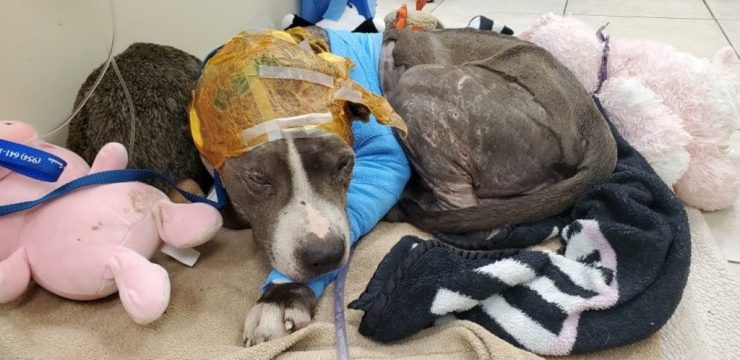
The rescue team acted quickly, knowing he needed urgent medical attention. Once he arrived at a veterinary facility, a series of examinations helped uncover the reasons behind his condition. The results revealed a serious spinal compression tumor that had taken away the function of his hind legs. As if that challenge were not enough, Atrey was also battling heartworm disease, a dangerous parasitic infection affecting his lungs and overall health.
For a dog who had spent so much time alone, receiving no medical care and little comfort, the diagnosis seemed overwhelming. The road ahead looked long and uncertain. Still, the people surrounding him refused to focus only on the obstacles. They began looking for signs of hope.
And hope appeared in the most unexpected way.
One day, someone handed Atrey a toy.
Almost instantly, his expression changed. His eyes brightened. His tail started wagging. For a moment, the pain, limitations, and difficult circumstances seemed to fade into the background. Despite everything he had endured, Atrey responded with pure happiness.
It was a powerful reminder that the spirit of a dog can remain remarkably strong even after experiencing tremendous hardship.
Encouraged by his resilience, the veterinary team moved forward with surgery to remove the spinal tumor. Everyone involved understood the risks, and naturally there was concern about what the outcome might be.
Then came the news they had hoped for.
The tumor was benign.
The result brought tremendous relief. Although many challenges still remained, Atrey had successfully overcome the most immediate threat to his future. The next chapter of his journey could finally begin.
Recovery required patience, dedication, and time.
To help him regain as much mobility as possible, Atrey was fitted with a specially designed wheelchair. The device supported his body while allowing him to move independently. Watching him explore his surroundings with newfound freedom was an emotional experience for everyone involved.
Rather than withdrawing or becoming discouraged, Atrey embraced the opportunity.
He learned how to navigate his environment with determination and confidence. His wheelchair did not represent a limitation. Instead, it became a tool that allowed him to experience life in ways that had once seemed impossible.
As rehabilitation progressed, physical therapists worked closely with him to strengthen weakened muscles and improve balance. Large therapy balls became part of his routine, helping target important muscle groups while encouraging proper posture and movement.
These sessions required effort from both Atrey and his caregivers.
Every exercise demanded patience. Every small improvement represented weeks of dedication. Yet no achievement was considered too minor to celebrate. A steadier stance, improved balance, or a stronger push forward became meaningful milestones along the way.
The people helping Atrey understood something important: healing is often measured through small victories rather than dramatic transformations.
Months passed, and Atrey continued making progress.
About nine months into his recovery, hydrotherapy was introduced as another part of his treatment plan. The water provided a supportive environment where he could exercise without placing excessive strain on his body. The buoyancy allowed him to engage muscles that were difficult to use on land while reducing discomfort.
Hydrotherapy was not easy.
Some days showed visible improvement. Other days felt slower and more challenging. Yet consistency remained the foundation of his care. The professionals and volunteers supporting him stayed committed, and Atrey continued showing the same determination that had carried him through every previous obstacle.
Nearly a year of rehabilitation eventually led to an important realization.
Atrey had achieved remarkable progress. He could stand independently and even take a few steps with effort. However, a complete recovery of his mobility was no longer realistic. The damage caused by his condition had been too extensive, and too much time had passed before treatment began.
For many, such news might have felt discouraging.
But the people who loved Atrey saw things differently.
They recognized that success is not always defined by perfection. Sometimes success means giving someone comfort, dignity, and the opportunity to enjoy life.
Instead of pushing him through endless therapy in pursuit of an outcome that might never come, they made a compassionate decision. They chose to focus on his happiness.
They chose to let Atrey simply live.
Today, that decision continues to shape his life in beautiful ways.
Atrey spends his days surrounded by safety, kindness, and care. His wheelchair helps him reach the places he wants to explore. The people around him provide encouragement, companionship, and affection. The chain that once limited his world has long since disappeared.
In its place are gentle voices, loving hands, and a comfortable place to rest.
His story is not one of perfect healing.
His back legs never fully regained their former strength. The challenges he faced left lasting effects that could not be completely erased. But that reality does not diminish the extraordinary transformation that occurred.
What makes Atrey’s journey so inspiring is not the achievement of a flawless outcome.
It is the fact that someone noticed him.
Someone stopped.
Someone cared enough to act.
Because of that decision, a dog who once faced an uncertain future now experiences security, companionship, and love. His life serves as a reminder that meaningful change often begins with a single act of compassion.
For anyone touched by Atrey’s story, there is an important lesson worth remembering. Every day, opportunities exist to make a difference in the life of another living being. Sometimes that difference begins with offering help when it is needed most.
Somewhere, another dog may be waiting for that chance.
Just as Atrey once was.
And sometimes, one caring decision can change everything.