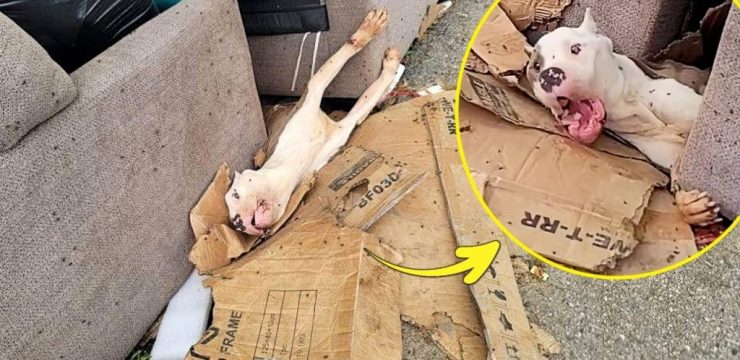
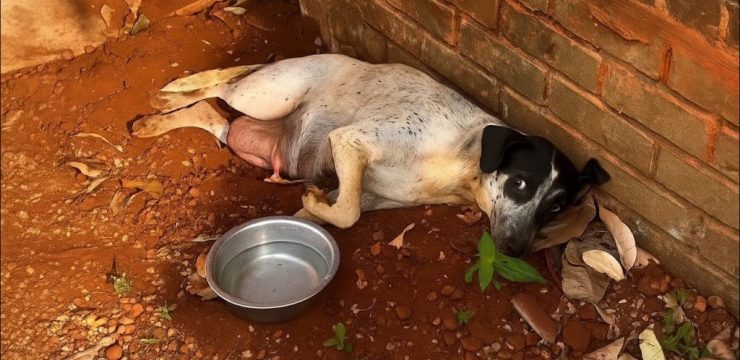
Along the side of a busy road, a tragedy unfolded in a matter of seconds. A small dog was struck by a passing vehicle, and the driver never stopped. For most animals, a moment like that could mark the end of the story. For Kimgun, a two-year-old dog whose life had barely begun, it became the start of an entirely different journey.

When rescuers found her, the situation was heartbreaking. The accident had caused a severe spinal fracture, leaving her hind legs completely paralyzed. By the time help arrived, the critical forty-eight-hour window for emergency nerve repair had already passed. The damage to her lower spine was permanent. She would never regain feeling in her hind legs. She would never be able to relieve herself without assistance. At only two years old, she was suddenly facing a future shaped by injuries she did not deserve.
Yet the physical damage told only part of Kimgun’s story.
The first time volunteers approached her, they noticed something that went beyond pain. She trembled at every movement. She pulled away from gentle hands. Even the softest voices seemed to make her nervous. The fear in her eyes suggested that her suffering had not started with the accident. Long before that terrible day on the roadside, she had already learned to be wary of people.
Whatever experiences she had endured in the past had left deep emotional scars. Trust did not come naturally to her. Safety was not something she expected. Kindness seemed unfamiliar. Looking at her fragile body and frightened expression, it was easy to understand why she struggled to believe that anyone truly wanted to help.
Kimgun was severely underweight and living with constant discomfort. Her body was exhausted, and her spirit seemed guarded behind a wall built from fear and disappointment. From her perspective, there was little reason to believe that help was finally coming.
But her rescuers saw her differently.
They understood the seriousness of her condition and accepted the difficult medical reality. The nerves in her lower spine could not be repaired. No procedure could restore what had been lost. No amount of therapy could return the feeling in her hind legs. Her paralysis was permanent.
Even so, they refused to define her future by what she could no longer do.
Instead, they focused on what was still possible.
Veterinary specialists recommended a corrective surgery designed not to reverse the paralysis, but to improve her quality of life. The injury had left her spine misaligned, creating ongoing discomfort and making future mobility support more difficult. Through careful surgical intervention, the team was able to straighten her spine and create a more stable foundation for the life ahead.
The procedure offered something invaluable. It gave Kimgun a chance to sit comfortably, move more easily with assistance, and live without the constant burden of unnecessary pain.
It was an act of hope.
The people caring for her believed that one day she would be ready to embrace a brighter future, even if she could not yet imagine it herself.
Recovery moved slowly. There were no dramatic overnight transformations. Progress came through patience, consistency, and compassion. Volunteers spent countless hours sitting beside her. They spoke softly and allowed her to move at her own pace. No one rushed her. No one demanded trust before she was ready.
Little by little, the fearful reactions began to soften.
The trembling became less frequent. The instinct to pull away started to fade. Curious glances gradually replaced fearful ones. Kimgun was beginning to understand that these people were different from those who had let her down before.
For perhaps the first time in a long while, she was learning that kindness could be real.
Then came one of the most important milestones in her recovery.
Kimgun received a custom-built wheelchair designed specifically for her needs.
At first, she seemed unsure. She stood quietly, trying to understand the unfamiliar equipment around her. The wheels felt strange. The movement felt different. She hesitated, taking in the experience with wide, uncertain eyes.
Then she took a step.
Moments later, she took another.
As the wheels rolled beneath her, something extraordinary happened. For the first time since the accident, Kimgun was moving forward under her own power.
It was not simply a practical tool.
It was freedom.
It was independence.
It was a reminder that her life was still full of possibilities.
Alongside her wheelchair training, Kimgun began a dedicated physical therapy program. The exercises focused on strengthening her core muscles and building endurance in her upper body. Day after day, she practiced. Session after session, she grew stronger.
Soon she learned how to maneuver around corners. She became more confident navigating different surfaces. In open spaces, she picked up speed and moved with growing excitement.
As her confidence increased, so did her joy.
The same world that had once caused her so much pain began to reveal a different side. She discovered caring people, gentle encouragement, and opportunities she never expected to have. Everywhere she turned, there seemed to be someone cheering for her success.
The transformation was remarkable.
The frightened dog who once flinched from human contact started seeking affection. The timid rescue who had hidden behind fear began greeting volunteers with bright eyes and a wagging tail. Her personality emerged more clearly with each passing day.
Kimgun was no longer merely surviving.
She was thriving.
Although she will never walk on all four legs again, she has shown that a meaningful life is not defined by limitations. She still requires extra care and ongoing support, but those needs do not diminish her happiness or her ability to enjoy each day.
Watching her race through the rescue center in her little wheelchair, ears bouncing and tail wagging, it becomes impossible not to smile. She carries herself with determination, enthusiasm, and a spirit that refuses to be defeated.
Kimgun’s story reminds us that healing does not always mean returning to the life we once had. Sometimes healing means creating something entirely new. It means finding strength within difficult circumstances and embracing opportunities that still remain.
Her journey stands as a powerful example of resilience, compassion, and second chances. Surrounded by people who refused to give up on her, Kimgun discovered trust, hope, and belonging once again.
Today, she moves forward on four small wheels and an unbreakable spirit, proving every single day that life after hardship can still be filled with joy.