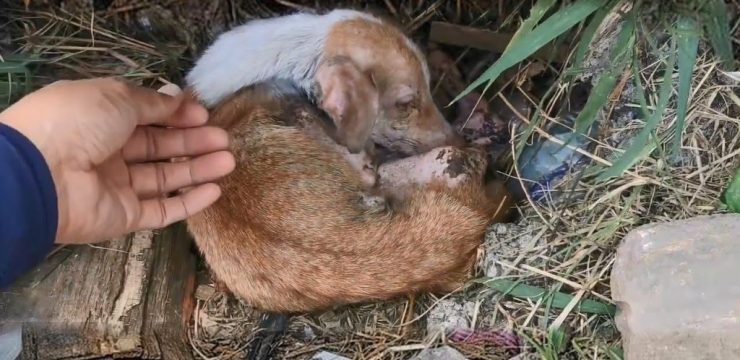
Marley’s story is the kind that quietly settles into the heart and stays there, especially for people who have lived long enough to understand how deeply neglect can mark a life. He was a senior dog discovered alone, carrying the silent burden of years without consistent care or comfort. His body was almost completely hidden beneath layers of painfully matted fur, so dense and hardened that it looked less like a coat and more like a stiff shell. This heavy mass restricted nearly every movement he attempted, tugging at his skin, limiting his vision, and turning even the simplest step into an exhausting effort.
When rescuers first met Marley, it was impossible not to notice the sadness in his eyes. Beyond his physical condition, there was an emotional weariness that spoke volumes. He seemed withdrawn and defeated, as if hope had slowly faded with each passing year. Those who cared for him later described his spirit as broken, a phrase that felt heartbreakingly accurate. Marley did not resist help or react with fear or aggression. Instead, he accepted his situation with quiet resignation, as though he had learned long ago not to expect kindness.

The turning point in Marley’s life began with something that might appear ordinary to many, yet was profoundly transformative for him: grooming. As the thick layers of matted fur were carefully and patiently removed, the true extent of his burden became clear. Nearly nine pounds of tangled hair were lifted from his small, fragile frame. With each section gone, Marley’s posture subtly changed. He stood a little taller, turned his head more freely, and breathed with noticeable relief. For the first time in years, his body was no longer trapped.
Beneath the mats, his condition revealed a deeper story of long-term neglect. Marley was undernourished, his body weakened by age and the absence of proper care. Medical examinations showed that he was positive for E. canis, a tick-borne illness that can quietly erode a dog’s health when left untreated. Yet even as these challenges came to light, something remarkable began to surface. As his physical discomfort eased, Marley’s true nature slowly emerged, gentle and surprisingly trusting.
What touched everyone most was his calm and affectionate demeanor. Despite all he had endured, Marley showed no bitterness and no signs of defensive behavior. He leaned into soft voices and gentle hands, as if recognizing that he was finally safe. Each caring interaction seemed to reassure him that this chapter of his life would be different. Over time, the tension in his body softened, and his eyes, once dull and guarded, began to reflect curiosity and quiet contentment.
Rebuilding trust is never easy, especially for an older animal who has spent so much time alone. Marley’s progress did not happen overnight, but it was steady and meaningful. Day by day, he became more relaxed and responsive. He began to seek out attention, resting calmly during care and finding comfort in simple companionship. These small changes spoke volumes, revealing a dog who had always been loving, patiently waiting for someone to notice.
Marley’s journey resonated deeply because it highlighted the resilience that can exist even in the most fragile lives. His age made his recovery especially powerful. Senior animals are often overlooked, their remaining years viewed as less important. Marley’s story challenges that belief, reminding us that love, dignity, and comfort matter at every stage of life, regardless of age.
As his health improved and his confidence grew, a new chapter quietly unfolded. Marley was adopted and transported to Germany, where a family welcomed him into their home. There, he found stability, warmth, and the consistent care he had long been denied. In this new environment, he was no longer defined by neglect, but by the simple pleasures of safety and belonging.
Today, Marley spends his days surrounded by people who cherish him. His story stands as a powerful reminder of the impact compassion can have, even when it arrives later in life. For those who understand the passage of time and the value of second chances, his transformation is deeply moving. It shows that healing is possible, dignity can be restored, and love, when finally given, can change everything.
Marley’s experience also invites quiet reflection on responsibility and empathy. Animals depend entirely on humans for care and protection, yet many endure years of hardship without a voice. Stories like his are not meant to shock, but to awaken awareness. They remind us that neglect often happens gradually, unnoticed, until the consequences become severe. At the same time, his recovery shows how powerful simple, consistent care can be. Proper nutrition, medical attention, patience, and affection may seem ordinary, but for Marley, they meant a complete transformation. For older readers who have witnessed both loss and renewal, this story carries a deeper message: it is never too late to offer comfort, never too late to make a difference, and never too late to receive love.