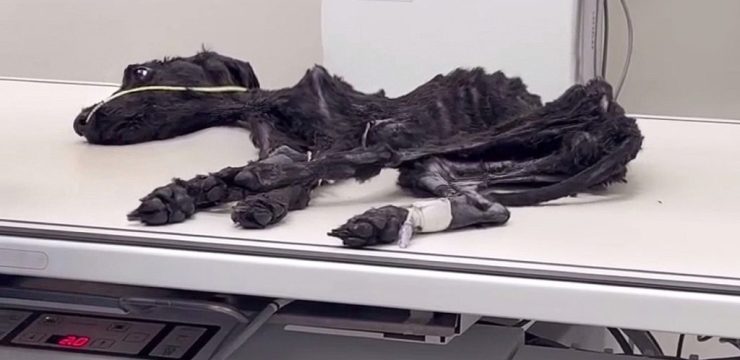
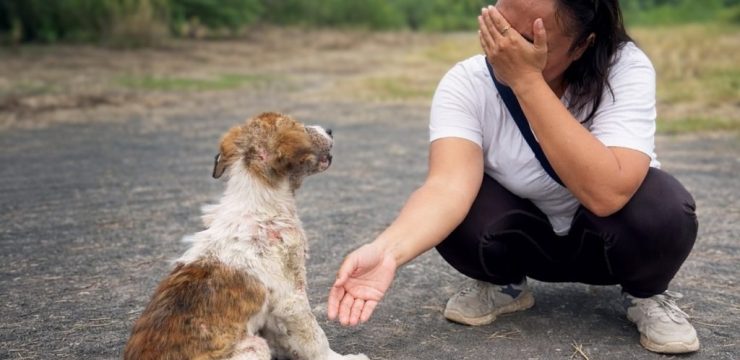
On a silent winter morning, when the world was still wrapped in frost, a faint cry broke through the quiet. It came from behind a small snow-covered house, barely audible yet full of pain. Following the sound, a passerby discovered Jem — a frail, trembling dog chained tightly to a post. The cold had bitten deep into his thin body; his fur was stiff with ice, and his eyes, glassy and sorrowful, pleaded silently for kindness. It was clear he had been left there far too long — no shelter, no food, no warmth, just the biting wind and endless snow.
The person who found him, shaken to their core, hurried to the house and asked the owner what had happened, hoping there was some mistake. The answer they received chilled them even more than the cold itself. The owner, unmoved, muttered that Jem “had made a mistake and deserved it.” Those words hung in the air like a cruel echo. In that moment, the rescuer knew they could not walk away. Jem’s suffering had gone on long enough.

Without hesitation, they called local authorities and arranged for Jem to be taken to the nearest veterinary clinic. When he arrived, the medical team rushed him inside, wrapping him in warm blankets and working to raise his dangerously low body temperature. Jem’s condition was critical — his breathing shallow, his body trembling uncontrollably. Even the gentlest touch made him flinch from pain and exhaustion. The veterinarians worked tirelessly through those first tense hours, fighting to keep him alive.
When Jem was finally stable enough, X-rays revealed the heartbreaking truth. Hidden beneath his fur were multiple bullets — four in total, one lodged perilously close to his spine. Alongside that, doctors discovered a degenerative spinal disease called spondylosis, which had left him paralyzed in his hind legs. Jem could no longer stand or walk on his own. Every movement came with pain. His weakened body had already endured more than most creatures could bear, and the medical team feared he might not survive the night.
The vets faced an impossible choice. Surgery might remove the bullets, but Jem’s frailty made the risk almost unbearable. There was a real chance that the operation would end his life. The reason behind this cruelty was as senseless as it was heartbreaking — his owner no longer wanted to care for an aging dog. Jem had not been punished for what he did, but for what he had become: a loyal friend whose years of devotion had been repaid with abandonment.
Yet the rescuer refused to give up. They believed Jem’s life still had meaning, that his story was not meant to end in that cold, lonely place. Arrangements were made to transfer him to a special rehabilitation center dedicated to long-term recovery. During the long drive through winding, snowy roads, Jem rested quietly in the back seat. Every now and then, he lifted his head to look out the window, and for the first time in years, there was something faint yet unmistakable in his eyes — hope.
At the center, Jem’s healing began one small step at a time. The caregivers spoke to him softly, their hands gentle as they worked to soothe his pain. He received daily therapy — warm massages to awaken his muscles, assisted exercises to teach his body how to move again, and words of encouragement that filled the room with warmth. Each day brought only the smallest progress, but every improvement mattered. One morning, Jem managed to twitch his hind legs ever so slightly. Another day, he wagged his tail when his rescuer entered the room. Those tiny moments were victories — quiet proof that life was returning to his fragile frame.
As weeks passed, Jem began to change. His haunted eyes softened, and his spirit — though scarred — started to heal. The rescuer visited him often, sitting by his side for hours. They brushed his fur, read to him softly, and fed him by hand. What grew between them was not pity, but love — the kind that comes from truly seeing another soul’s courage. Jem had been broken, but never defeated. His rescuer saw in him the heart of a survivor, a gentle strength that no cruelty could erase.
When Jem was finally strong enough, the rescuer made a life-changing decision: to bring him home. The house that had once felt quiet now filled with new warmth — the sound of Jem’s paws on the floor, the soft laughter of a young girl who quickly became his best friend. She adored him completely, wrapping her little arms around his neck, whispering secrets into his ears, brushing his golden fur with care. To her, Jem was not broken or old. He was family — her loyal companion, her gentle protector, her miracle.
Though Jem’s legs never regained full strength, his new life overflowed with love and dignity. His family fitted him with a small wheelchair so he could move freely again. Every morning, he joined them for slow walks through the garden, his wheels tracing neat lines in the dew. He would pause to breathe in the morning air, lift his face toward the sun, and let its warmth sink into his fur — a simple joy that once seemed lost forever.
Now, Jem spends his days surrounded by love. He naps by the fireplace, watches the snowfall from the window, and waits patiently for the little girl to come home from school. In the evenings, she lies beside him on the rug, reading stories aloud as his head rests on her lap. Sunlight spills across the room, bathing them both in a golden glow — a soft reminder that healing, no matter how slow, is always possible when love leads the way.
Jem’s journey is more than a story of survival. It is a testament to the resilience of life, the quiet miracle of second chances, and the compassion of those who refuse to turn away. His story reminds us that every living being — no matter its age, scars, or struggles — deserves care, respect, and the chance to live without fear or pain.
Today, Jem’s eyes no longer hold sorrow. Instead, they reflect peace — the kind that comes when one has finally found home. He has become a symbol of hope, proof that even after the coldest winters, warmth can return, and hearts once shattered can learn to trust again.