Dry leaves shifted beneath her paws as the mother dog lay among the trees. Against her belly, small cream and golden puppies nursed, their bodies gathered close to hers. The woodland was quiet, but their faint squeaks and her low whimpering revealed a family struggling beneath the autumn branches.
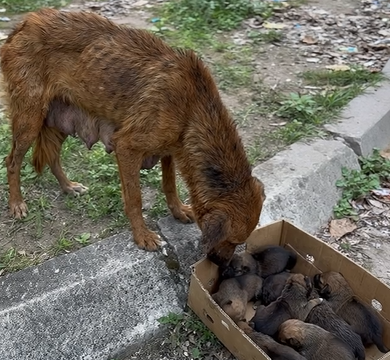
The mother had brown and tan fur and a dark muzzle. Her body was thin, her long legs stretched loosely across the ground. Her tail rested motionless among the leaves. With her head held low and her mouth slightly open, she appeared deeply exhausted, unable to find an easy resting position.
Around her, the puppies moved with the small, insistent motions of babies seeking nourishment. Their coats caught what little light reached the forest floor. They stayed pressed against her side, depending on the warmth and contact she could offer while her own condition showed how much she needed care.
There was no food or clean water visible nearby. Fallen leaves and flattened grass formed their bedding, with brittle twigs scattered beneath and around them. The trees offered little protection from the cold breeze. For this vulnerable family, the hollow lacked the comfort and security of a sheltered resting place.
Above them, tangled branches held a few yellowing leaves. Slender trunks stood against the gray distance, and muted light filtered through the sparse canopy. Every ordinary detail made their presence feel more exposed: the open ground, the moving air, the small bodies lying where autumn had left its debris.
The mother’s shoulders trembled, and the shaking continued down her legs. Her puppies quivered against her as they nursed. Their closeness was touching, but it could not meet all their needs. They required more than the contact of one another’s bodies in a place that offered so little else.
Her breathing sounded strained and uneven. The movement of her ribs was visible beneath her coat, each breath drawing attention to her weakness. Even lying still seemed difficult. The puppies continued seeking nourishment beside her, unaware of the concern her appearance would raise in anyone watching closely.
A soft whimpering rose from her and lingered in the quiet. Sometimes a thinner cry interrupted it before fading among the trees. The puppies added their own small squeaks. Together, those sounds brought the family into focus, turning an apparently empty stretch of woodland into a place that urgently needed attention.
Leaves crackled when the mother adjusted her legs. Grass rustled beneath the puppies, and a breeze moved through the branches overhead. No reassuring voice was heard in the scene. The forest seemed large around them, while their resting place was no more than a small patch of covered earth.
Then the mother began lifting her head.
She raised her dark muzzle slowly and turned toward the camera. Her eyes glistened as she blinked, with moisture tracing her face. For a moment, she held her gaze toward the nearby presence. The movement appeared tiring, yet it brought her features clearly above the puppies clustered beside her.
Her head lowered again, coming close over the little ones. Her legs shifted weakly through the leaves before she looked up once more. It was a brief movement, but an affecting one: a worn mother remaining responsive while her babies continued relying on her in that exposed place.
It is natural to see an appeal in a look like hers. We cannot know precisely what she understood, but we can recognize her distress. She did not need to demonstrate hope or bravery to deserve help. Neither did the puppies whose needs were quieter, partly hidden against her body.
The scene does not establish how long the family had been there or explain everything that brought them into the woods. Her thinness cannot tell us that she deliberately denied herself food. What is clear is that she was nursing her puppies while visibly weak, with no dependable care shown nearby.
For many readers, the image may recall people who cared for others while needing support themselves. We remember mothers stretching a meal, grandparents staying close through illness, or someone putting another person’s comfort first. Those memories can deepen our compassion without requiring us to pretend we know this dog’s thoughts.
Her continued care for the puppies was moving, but her exhaustion was not something she should have had to endure. She deserved nourishment, rest, and attention in her own right. Helping the family meant helping her too, recognizing that the little ones depended on a mother who also needed protection.
We can imagine the relief of clean bedding and shelter from the wind. We can hope for appropriate care and a safer place for the entire family. Those are wishes, however, rather than outcomes confirmed here. Their story remains meaningful without adding a rescue or recovery that has not been described.
Compassion becomes useful when noticing leads to thoughtful action. Contacting an appropriate rescue organization, sharing accurate information and a clear location, or supporting those who care for animals can help connect concern with assistance. Small contributions matter when they become part of the dependable care vulnerable animals require.
Remember the brown mother lifting her face above the fallen leaves, with cream and golden puppies gathered beside her. They deserved more than a hidden hollow and the warmth they could share. May their image encourage us to listen carefully in quiet places, recognize distress, and help kindness reach those who cannot seek it themselves. This family deserved safety, together, somewhere.