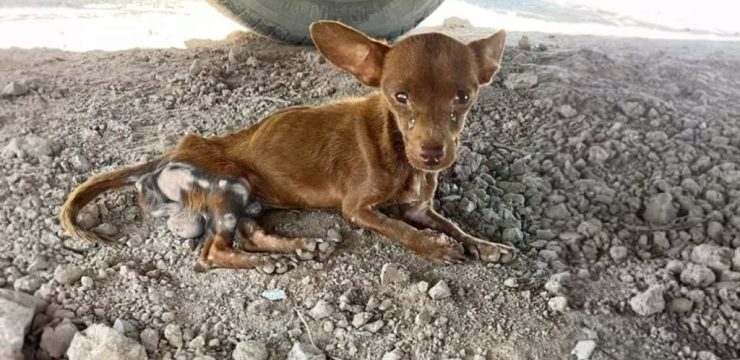
On a cold street corner, a small dog lay motionless, too exhausted to lift his head. People passed by without knowing his story, without realizing how much suffering had already been packed into his short life. Later named Luke, the tiny dog appeared to have been discarded as though he were invisible, as though his life carried no value at all. Yet one look at the wound on his head made it clear that something terrible had happened long before he was found.

The injury immediately caught the attention of rescuers. A deep cut had been stitched closed, but dried blood remained tangled in his fur. At first, there was hope that the wound might have been the result of some unfortunate accident. The rescue team wanted to believe that possibility. However, once Luke was transported for a full medical evaluation, the truth proved far more serious than anyone expected.
Veterinary specialists performed advanced imaging to understand the extent of the damage. The MRI revealed severe trauma inside Luke’s skull. Fluid had accumulated in a dangerous area and was placing pressure on his cerebellum, the part of the brain responsible for balance, coordination, and many essential bodily functions. The findings were alarming. This was not a recent injury, and the evidence suggested it had not happened by accident.
As veterinarians and rescuers worked together to understand the situation, a heartbreaking picture began to emerge. It appeared that someone had discovered Luke was suffering from a serious medical condition. Instead of seeking proper treatment, a different choice had been made. The injury on his head suggested that tremendous force had been involved. Afterward, the wound had been stitched, and Luke had been abandoned on that lonely street corner. Left behind, he was expected to disappear quietly without anyone asking questions.
But Luke’s story was not over.
Against considerable odds, he survived the initial trauma. His small body continued fighting even when the circumstances seemed impossible. The rescue team watched carefully as he stabilized enough to undergo a minor procedure designed to begin relieving some of the pressure caused by the injury. For the first time in days, there was cautious optimism. The road ahead remained uncertain, and a major surgery would eventually be necessary to properly drain the fluid affecting his brain. Before that could happen, Luke needed time to recover and regain strength.
A loving foster home became the next chapter in his journey.
For the first time in what may have been a very long while, Luke experienced safety and comfort. The environment was quiet, warm, and filled with patience. He was taken on gentle walks where he could enjoy fresh air and peaceful surroundings. Because he was thin and vulnerable, he wore a cozy sweater that helped keep him warm. Watching him walk beside his caregiver, it was difficult to imagine everything he had already endured.
What touched people most was his ability to trust.
Despite the pain he had experienced, Luke leaned into affection. He accepted gentle attention from the people caring for him and seemed grateful for every moment of kindness. There were no grand gestures, only small everyday moments that became deeply meaningful. Quiet mornings, slow walks, soft blankets, and reassuring voices helped him discover what it felt like to be cherished.
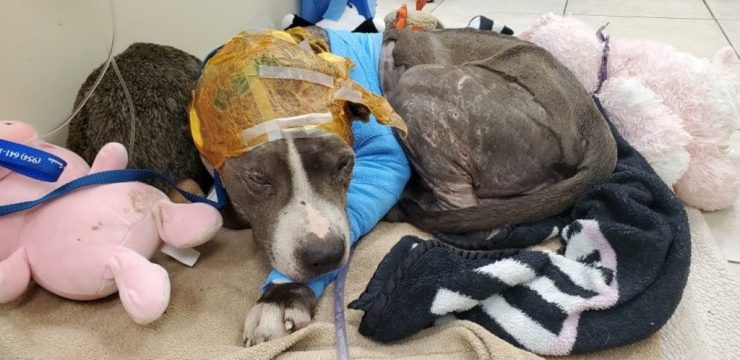
Because his head remained sensitive during recovery, veterinarians recommended a protective covering. Luke was fitted with a small pink hat designed to help shield the vulnerable area while he healed. The hat quickly became one of the most memorable parts of his story.
Luke clearly preferred life without it.
Whenever the hat was placed on his head, he would shake, wiggle, and attempt to free himself. His expressions often made everyone laugh. He seemed determined to voice his opinion about the situation. Yet after each playful protest, he eventually settled down and accepted it. To those who knew him, it felt as though he understood that the people around him were trying their best to protect him.
That trust became one of the most beautiful parts of his journey.
As the weeks passed, Luke gradually grew stronger. His caregivers celebrated every sign of progress. They knew the major surgery still awaited him, but they also knew he had already overcome challenges many believed impossible. Every day he spent surrounded by love felt like a victory.
Eventually, the day of the operation arrived.
The veterinary team prepared carefully for the complex procedure. Although significant risks were involved, there was also hope. Everyone who had followed Luke’s recovery believed he deserved the chance to continue healing. The little dog who wore the sweater and protested the pink hat had touched countless hearts.
Then, during surgery, everything changed.
Once the surgical team gained a clearer view of the injury, they discovered a severe bacterial infection deep within the affected area. The infection had spread extensively in ways that previous imaging could not fully reveal. Despite the knowledge, experience, and dedication of the medical team, the condition was beyond treatment. No viable option remained that could offer Luke a meaningful recovery.
The heartbreaking reality became impossible to avoid.
Luke passed away during the procedure, surrounded by people who cared deeply about him.
For the rescuer who had walked beside him through every stage of recovery, the loss was profound. In only a few short weeks, an extraordinary bond had formed. The love shared between them was genuine, and so was the grief that followed. Losing an animal you have fought so hard to save creates a unique kind of heartbreak. It is not only sadness. It is the realization of how much hope had been invested and how deeply that small life mattered.
Yet Luke’s story is not defined by tragedy alone.
It is also a story about compassion, commitment, and dignity. His rescuers could not change what happened before he was found, but they changed everything that came after. They gave him comfort. They gave him safety. Most importantly, they gave him love.
Luke did not spend his final days alone on a cold street corner. He spent them surrounded by people who saw his value, fought for his future, and cared for him with all their hearts. His journey reminds us that rescue work is not always measured by happy endings. Sometimes it is measured by the kindness offered along the way.
Luke was seen. He was protected. He was loved. And long after his passing, those who knew his story continue to carry his memory with them.
That matters more than words can ever fully express.