For fourteen long years, a senior dog named Lucky knew only one way of life. From the time he was young until his body grew old and weary, he remained attached to a chain no longer than a single meter. That short length of metal defined his entire world. It determined where he could stand, where he could sleep, and how far he could move. Day after day, year after year, he lived within the same tiny circle, watching life pass by beyond his reach.

For the first eleven years, Lucky served as a factory guard dog. He was expected to be loyal, alert, and dependable. He fulfilled that role faithfully, yet no one seemed to consider what he needed in return. He spent his days on hard concrete and worn dirt, exposed to the elements and deprived of the freedom every dog deserves. His owner never questioned whether a life spent at the end of a chain was fair. It was simply the way things had always been.
When the owner eventually retired from factory work, Lucky’s circumstances did not improve. Instead of finally experiencing the comfort of a home, he was brought to another location where the same pattern continued. Another chain replaced the old one. Another small patch of ground became his prison. For three more years, he endured the same lonely existence, growing older and weaker with each passing season.
When rescuers finally discovered him, the effects of those fourteen years were impossible to ignore.
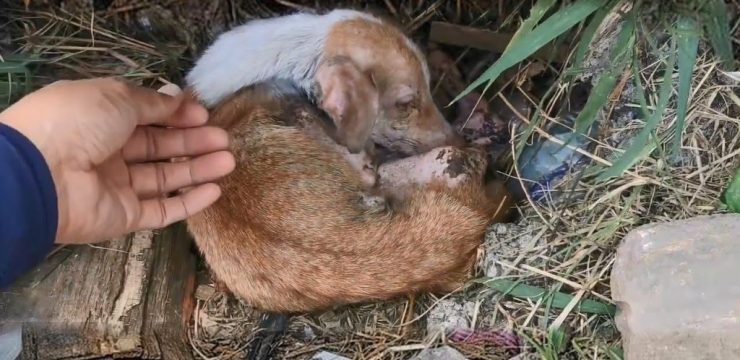
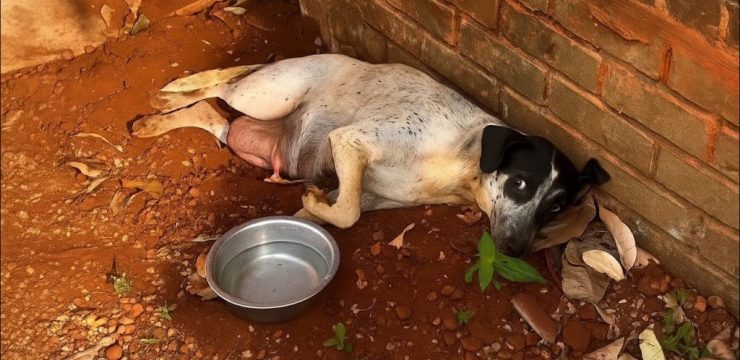
His body reflected a lifetime of neglect. Severe sores covered portions of his skin. One of his front legs suffered from painful ulcerations that had clearly gone untreated for far too long. Around his neck, deep scars revealed where the heavy chain had rested year after year. He looked exhausted, frail, and worn down by time. Most heartbreaking of all was the realization that he had likely spent his entire life without experiencing the simple comfort of gentle affection.
The rescue team knew they had to help.
When they spoke with the owner, however, they encountered resistance instead of concern. The dog was viewed as property rather than a living companion. To the owner, Lucky represented something of value to keep, not a soul in need of care. It ultimately required the involvement of local authorities before rescuers were able to remove him from the place where he had spent nearly his entire life.
The moment Lucky left that chain behind marked the beginning of a completely different future.
At the veterinary hospital, doctors conducted a thorough examination and quickly realized how serious his condition truly was. Years of neglect had affected nearly every part of his body. He was diagnosed with pneumonia, making it difficult for him to breathe comfortably. His heart showed signs of edema related to filariasis. His vision had been greatly reduced by severe cataracts that had likely developed over many years without treatment.
Perhaps the most devastating discovery involved his front legs. Because he had spent so much of his life unable to move freely, the nerves in those limbs had suffered extensive damage. A lifetime of restriction had robbed him of the ability to use his legs normally. The very thing every healthy dog is born to do—run, explore, stretch, and play—had been denied to him for so long that his body had paid a heavy price.
Yet despite everything he had endured, Lucky remained remarkably gentle.
The veterinary staff were touched by his calm nature. They chose the name Lucky for him, though at the time it felt more like a hopeful wish than a reflection of reality. Still, there was something special about him. He seemed to sense that the people around him wanted to help. When caring hands reached out to comfort him, he did not pull away. Instead, he leaned into their touch, accepting kindness as though he had been waiting for it his entire life.
Recovery required patience and dedication.
Every day brought new treatments and therapies. Veterinary specialists carefully addressed his medical conditions while volunteers spent time beside him, offering companionship and encouragement. Acupuncture sessions were introduced in an effort to stimulate the damaged nerves in his legs. Physical therapy exercises helped strengthen weakened muscles and improve mobility.
Progress came slowly, but it came.
Nutritious meals gradually restored weight to his thin frame. His body began receiving the nourishment it had lacked for so many years. The company of other dogs introduced him to simple joys he had never truly experienced before. For perhaps the first time in his life, he was surrounded by warmth, safety, and friendship.
Week after week, the changes became more noticeable.
The sores on his skin began to heal. The painful wounds gradually closed. His coat, once dull and patchy, started growing back softer and healthier. Veterinary treatment improved his eye condition enough to allow more light into his world. The dog who had arrived looking defeated slowly began carrying himself with renewed confidence.
Those who cared for him noticed something beautiful happening.
As his body healed, so did his spirit.
The most unforgettable milestone came when Lucky received a custom wheelchair.
Although his front legs remained weakened by years of nerve damage, the wheelchair offered something he had never truly possessed before—independence. For the first time, he had the opportunity to move forward without being restricted by a chain.
Learning to use the wheelchair required practice. At first, every movement felt unfamiliar. But Lucky approached the challenge with determination. Day after day, he practiced, growing more comfortable and confident with each attempt.
Then came a moment that nobody who witnessed it would ever forget.
Outside beneath the open sky, surrounded by fresh air and sunlight, Lucky took his first real walk.
No chain held him back.
No boundary limited his movement.
No worn circle of dirt defined his world.
He moved forward freely, exploring a life that had been denied to him for fourteen years.
The sunlight warmed his back as he traveled across the ground. Gentle breezes carried new scents past him. People who genuinely cared walked beside him, cheering him on every step of the way. It was a simple moment, yet it carried extraordinary meaning.
Lucky had spent most of his life being treated as property.
Now he was treated as family.
The final chapter of his story became one of dignity, comfort, and love. Though his difficult past could never be erased, it no longer defined him. Instead, he became a symbol of resilience and hope.
His journey reminds us that it is never too late to change a life. Compassion matters, even when it arrives after years of hardship. Every act of kindness has the power to create a new beginning.
For fourteen years, Lucky waited.
Then someone finally came.
And everything changed.