There are certain stories that stay with you long after you hear them. They remind us that animals experience fear, heartbreak, and hope in ways that are often deeper than we realize. They also show us how powerful kindness can be when it reaches a soul that has known nothing but hardship. Catarina’s story is one of those unforgettable stories.

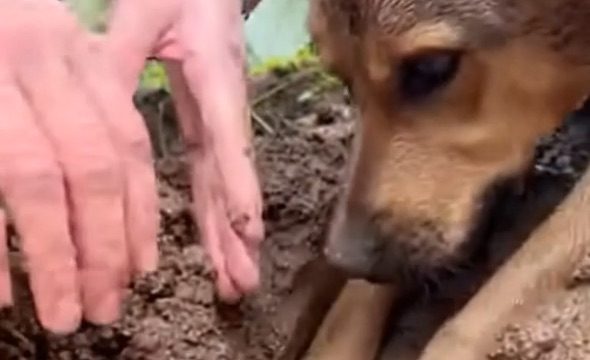
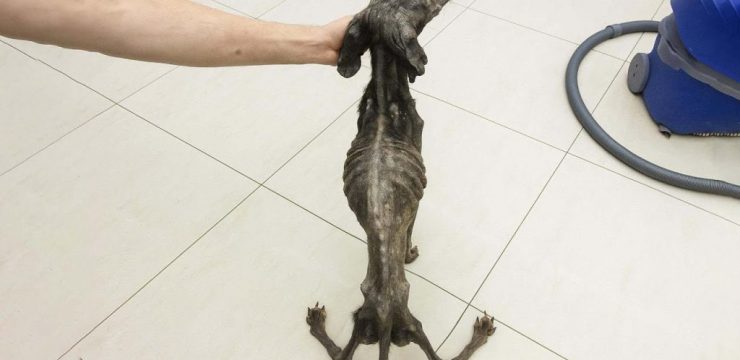
When rescuers first found her, Catarina was a small and fragile dog, curled tightly into herself beside a worn plastic bowl near a cold wall. She looked as though she was trying to disappear from the world around her. Her body trembled constantly, and her eyes moved nervously from one sound to the next. Every shadow seemed to frighten her. Every movement caused her to tense.
It was immediately clear that this was not simply a dog who had spent time without a home. Catarina carried a deeper kind of pain. The fear visible in her eyes suggested a history of repeated disappointment and suffering. She had learned to expect danger instead of comfort whenever people were nearby.
At some point in her life, Catarina had likely done what many homeless animals do. Searching for safety, she found her way into a building where she hoped to find shelter from the outside world. Like countless other stray animals, she was looking for a warm place to rest and a chance to exist peacefully.
Unfortunately, she did not find understanding there.
Instead of being welcomed or even tolerated, Catarina was pushed away. The people living in the building made it clear that they did not want her around. Rather than seeing a frightened animal in need, they treated her presence as a problem.
For a dog already struggling to survive, that rejection alone would have been difficult enough. But what happened next was far worse.
Food containing poison was left where Catarina could reach it. Whether it was done intentionally or through carelessness, the outcome was devastating. Catarina nearly lost her life after eating it. The tiny dog suffered greatly, and for a time her future hung in the balance.
Against the odds, she survived.
Yet surviving did not erase the damage. Physical recovery was only one part of her battle. The emotional wounds left behind would prove much harder to heal.
Rather than showing concern for what had happened, the residents later contacted local authorities and requested that Catarina be removed. Once again, she received the message that she was unwanted.
Imagine what experiences like that teach an animal.
Every encounter Catarina had with people reinforced the same painful lesson. Human beings were not a source of safety. They were a source of fear. They brought uncertainty, rejection, and harm.
As a result, Catarina adapted the only way she knew how.
She hid.
She pressed herself into corners where she hoped no one would notice her. She avoided attention whenever possible. Even the smallest movements nearby caused her to flinch. Sometimes she let out a low growl, not because she wanted to hurt anyone, but because she was terrified and exhausted.
What many people misunderstand about frightened animals is that fear can look similar to aggression. Catarina was never a dangerous dog. She was simply a deeply traumatized one.
When the rescue team finally arrived, they approached her carefully. They brought food and attempted to show her kindness. To most dogs, a meal offered by a caring person might be comforting. For Catarina, however, trust did not come so easily.
She refused to eat while anyone stood nearby.
Instead, she sat still and watched. Her eyes remained fixed on the rescuers as her body shook with anxiety. She could not yet believe that these people were different from the others she had known.
The rescuers understood this.
Rather than forcing interaction, they gave her something she desperately needed: patience.
Patience is one of the greatest gifts that can be offered to a frightened animal. Trust cannot be demanded. It cannot be rushed. It must be earned slowly, one gentle moment at a time.
After Catarina was safely transported to a shelter, she experienced something that may have been unfamiliar to her—a warm and comfortable place to sleep indoors.
To many of us, that might seem like a simple thing. For Catarina, it represented a completely different world.
The shelter provided security, consistency, and care. Still, recovery did not happen overnight.
She remained cautious around people she did not know. Men seemed to make her especially nervous, suggesting there may have been painful experiences in her past that contributed to those fears. Whenever unfamiliar individuals entered the room, she became tense and hesitant.
Even mealtime remained difficult.
If strangers were nearby, Catarina often refused to eat. She needed reassurance that she was safe before she could relax enough to focus on something as basic as a meal.
The rescue team respected her boundaries.
They did not pressure her to become comfortable before she was ready. Instead, they allowed her to move at her own pace.
As the days passed, they began noticing something remarkable.
Despite everything she had endured, Catarina never attempted to bite anyone.
Not once.
There were moments when fear overwhelmed her. There were times when she desperately wanted to run away from an approaching hand. Yet she never chose to respond with aggression.
She retreated instead.
That quiet restraint revealed something extraordinary about her character. Beneath the fear and anxiety was a gentle spirit that had not completely given up.
Little by little, changes began to appear.
The trembling that once seemed constant became less frequent. Her reactions to movement softened. The panic that had controlled so much of her behavior slowly started to loosen its grip.
Most importantly, her eyes began to change.
Where there had once been only fear, rescuers started to notice curiosity.
It appeared in small moments.
A brief pause before she moved away.
A longer glance toward a caregiver.
A willingness to remain in a room instead of immediately seeking the nearest corner.
These tiny victories might seem insignificant to an outsider, but they represented meaningful progress. Healing rarely arrives through dramatic transformations. More often, it happens through small steps that quietly build upon one another.
For Catarina, recovery looked like eating a meal without trembling as much as before.
It looked like accepting someone’s presence for a few extra seconds.
It looked like choosing a slightly more open space instead of hiding in the darkest corner available.
Each of those moments mattered.
Today, Catarina’s journey is still unfolding. She continues to learn about the world around her. She continues to evaluate, one careful day at a time, whether people can truly be trusted.
What matters most is that she no longer faces that challenge alone.
She is safe.
She is protected.
And she is surrounded by individuals who understand that trust is a gift that must be earned through consistency, gentleness, and respect.
Stories like Catarina’s are painful to hear, but they are also important. They remind us that the animals who seem hardest to reach are often carrying the heaviest burdens. They remind us that emotional wounds can last long after physical ones have healed. Most importantly, they show us that compassion has the power to change lives.
Catarina was let down by some people during the most vulnerable moments of her life. Today, she is being supported by others who refuse to give up on her.
And that is the part of her story worth remembering—the proof that patience, kindness, and understanding can help even the most frightened heart begin to believe again.