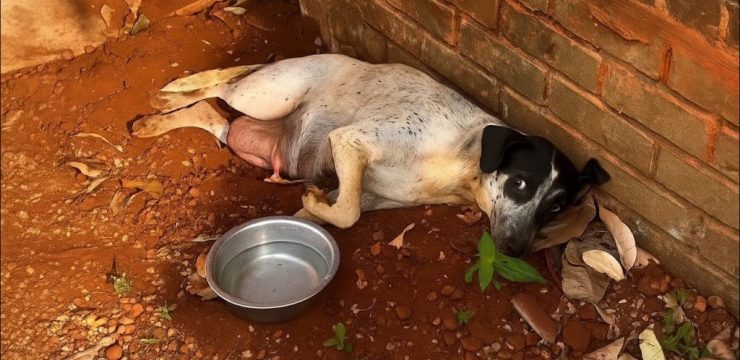
Julius’s story begins in a way that is almost too painful to imagine, a moment of cruelty that could have easily marked the end of his life. He was discovered zipped inside a suitcase and left alone in an open grassy field, exposed to the elements and trembling with fear. The small black dog, gentle by nature, had been abandoned without any regard for his survival. When rescuers finally found him, they were met with a sight that left them shaken to their core. Julius was blind, unable to walk, soaked through from the rain, and so weak he could not even lift his head. It was difficult to comprehend how anyone could leave a vulnerable animal in such a helpless state, facing suffering and near-certain death without a second thought.

Despite the shock and heartbreak, the rescue team did not hesitate. They knew every second mattered. Carefully lifting his fragile body, they rushed Julius to a nearby animal hospital where a team of dedicated veterinarians began assessing his condition. What they discovered was deeply concerning. After running a series of tests, the medical team suspected that Julius was suffering from advanced distemper, a serious viral illness that affects the nervous system. His body was severely undernourished, dangerously dehydrated, and plagued by frequent seizures that left him exhausted and trembling. Blood tests revealed another troubling issue—his bone marrow was barely producing enough red blood cells, leaving his already weakened system struggling to function.
For the veterinarians, the outlook was discouraging. They explained to the rescuers that Julius’s chances of recovery were extremely low. Some gently suggested that letting him go might spare him further suffering. It was not said lightly, but from a place of concern and realism. Yet those who had found Julius could not bring themselves to accept that path. When they looked at him, even through the cloud of his blindness, they saw something more than illness. They saw a quiet will to live. In that moment, they made a promise to him—to stand by his side and fight for him, for as long as he was willing to keep going.
The first nights were filled with uncertainty. Julius’s condition was fragile, and each passing hour felt like a fragile test. His seizures drained what little strength he had left, and his body struggled to maintain stability. Still, his rescuers remained close. They spoke to him in soft, reassuring voices, offering comfort in ways he could understand. They wanted him to feel, perhaps for the first time in a long while, that he was not alone. Then, something remarkable happened. After one especially difficult night, Julius made it through without experiencing a seizure. By morning, there was a subtle change. He seemed more aware, more present. When he let out a faint, fragile bark, it brought tears to the eyes of everyone in the room.
That small sound carried enormous meaning. It was a sign that Julius still had the desire to live. Soon after, he surprised everyone again by managing to eat on his own. For a dog who had been too weak to even lift his head, this moment felt nothing short of extraordinary. It was more than nourishment—it was a declaration that he was still fighting, still pushing forward despite everything he had endured.
The road to recovery, however, was far from easy. Julius required intensive care, including medications to stabilize his nervous system, fluids to restore hydration, and constant monitoring to ensure he continued moving in the right direction. One of the greatest challenges lay in rebuilding his physical strength. His muscles had weakened to the point where standing and walking seemed almost impossible. Yet, with patience and unwavering support, his caregivers began guiding him through gentle physical therapy exercises designed to help him regain mobility.
Progress came slowly, but it came. At first, Julius needed full assistance just to stand. Then, little by little, he began to take uncertain steps. Each movement, no matter how small, was celebrated with joy and encouragement. Over time, those hesitant steps turned into more confident motions. His rescuers cheered him on, recognizing that every bit of progress was a victory worth honoring.
As his body grew stronger, Julius’s personality began to shine through. Though he could not see, he responded to the voices and touch of those around him with remarkable trust. His once faint bark grew clearer and stronger, a reflection of his resilience. He wagged his tail when he heard familiar voices and leaned gently into the hands that comforted him. These simple gestures spoke volumes, showing that his spirit had not been broken by the hardship he had faced.
Julius’s journey is still unfolding, and he will likely require ongoing care for the rest of his life. But what has already been achieved is something truly meaningful. He is no longer invisible, no longer forgotten. He is surrounded by people who care deeply for him, who have shown him that his life holds value and that he belongs.
His story ends with a powerful truth. Whoever left him behind believed his life did not matter. They were wrong. Julius stands as living proof that hope can take root even in the darkest circumstances, and that compassion has the power to transform even the most painful beginnings into something meaningful.
For those who hear about him, Julius represents more than one dog’s struggle. He is a symbol of resilience and a reminder of the difference kindness can make. His journey encourages us to notice, to care, and to act when we see suffering. Because sometimes, all it takes to change a life is the decision to step in and believe that every life is worth saving.