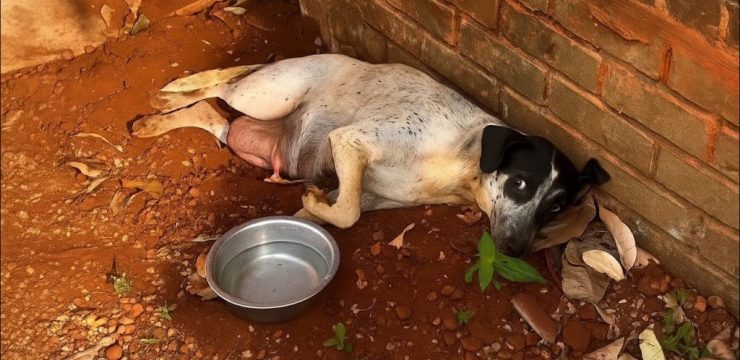
Eva’s story began in a place where suffering often goes unnoticed, where the struggles of vulnerable animals can quietly fade into the rhythm of everyday life. In Playa del Carmen, she lay motionless, her small body pressed against the ground, unable to move her back legs. People passed her by. Some may have glanced in her direction, while others chose not to linger. But for Eva, there was no escape from the pain that held her still. Her body was fragile, yet somewhere deep within, her spirit continued to endure.
When rescuers finally arrived, they immediately recognized how serious her condition was. This was not simple exhaustion or temporary weakness. Eva was paralyzed. Her back legs showed no response, and even the slightest movement caused her visible discomfort. Still, her eyes spoke volumes. There was fear, yes, but also something more powerful—a quiet hope, a gentle plea that someone might finally see her, truly see her, and offer help.

Veterinarians conducted careful examinations, determined to understand the extent of her injuries. The diagnosis confirmed their concerns. Eva had suffered significant damage to two vertebrae, injuries severe enough to take away her ability to walk and leave her in ongoing pain. The exact cause could not be confirmed, but it was likely the result of a traumatic event, perhaps an accident or an act of harm. Whatever had happened, it had changed her life in a single moment.
For many animals, this might have marked the end of their journey. But for Eva, it became the beginning of something new.
The rescue team refused to give up on her. They understood that recovery would take time, patience, and unwavering dedication. There were no guarantees, only the possibility—however small—that she could regain some of what had been lost. With that hope in mind, they created a structured rehabilitation plan, one built on consistency, compassion, and belief in her strength.
Each day started with gentle massages, carefully designed to stimulate her muscles and improve circulation. These moments were more than therapy; they were the foundation of trust. At first, Eva’s body responded with stiffness, her movements hesitant and uncertain. But slowly, almost imperceptibly, changes began to take shape.
Every few days, electrical stimulation was introduced to encourage activity in her weakened back legs. The process was handled with great care, ensuring that Eva remained as comfortable as possible. Progress did not come quickly, but these treatments helped awaken parts of her body that had long been silent.
Water therapy soon became an essential part of her recovery. In a controlled environment, supported by caring hands, Eva experienced a new sense of freedom. The water reduced the strain on her body, allowing her to move in ways she could not on land. It was here that something remarkable began to happen. Her legs, once completely still, started to respond. At first, the movements were small, barely noticeable, but they carried immense meaning. They were signs of life returning.
Days turned into weeks, and those small movements grew stronger. Eva’s back legs gradually gained strength, while her front legs regained flexibility and coordination. Each step forward, no matter how modest, was celebrated. A slight shift in balance. A longer stretch. A moment of standing just a bit steadier than before. These milestones, though quiet, represented something deeply meaningful.
The team often described her progress as significant, not because it happened quickly, but because it revealed her resilience. Healing, they knew, is rarely dramatic. More often, it unfolds gently, built on patience and countless small victories that add up over time.
As her physical strength improved, so did her spirit. The dog who once lay still and silent began to show curiosity about the world around her. She engaged more, responded to gentle voices, and even showed glimpses of joy. Her eyes, once clouded with uncertainty, began to shine with a renewed sense of life.
Within two months, the transformation was clear. Eva could walk again. It was not perfect, and her steps were still careful, but they were her own. She began exploring her surroundings, each step carrying her further away from the helplessness she once knew. One of the most meaningful moments came when she returned to the beach. The same place where she had once been found unable to move had become a space of freedom. She walked along the sand, feeling it beneath her paws, embracing a life that had once seemed out of reach.
Yet her journey did not end there.
After three months of dedicated therapy, Eva was ready for the next chapter—a permanent home. She was adopted by someone who saw beyond her past and recognized her strength, her resilience, and her gentle spirit. Soon after, she traveled to Canada, leaving behind the place where her story began and stepping into a future filled with care, safety, and affection.
Eva’s story is about more than recovery. It is a testament to compassion, persistence, and the quiet miracles that can unfold when someone chooses to care. She was once a dog left behind, unable to move, her future uncertain. Today, she stands as living proof that even in the face of overwhelming challenges, a second chance can change everything.
Her journey speaks to something deeply human—the belief that no life is beyond hope, that kindness has the power to reach even the most overlooked corners of the world. And perhaps most importantly, it reminds us that sometimes, all it takes is one person to pause, to notice, and to say, “This life matters.”
Because for Eva, that single moment made all the difference.