Millie was seven years old when her world quietly fell apart. After years of belonging to a family she trusted, she was abandoned and left emotionally shattered. The loss was not loud or dramatic. Instead, it appeared in silence—in the way she pressed her trembling body into the farthest corner she could find, as if she hoped the world might forget she was there.
Fear seemed to surround her like a shadow that would not lift. She avoided every glance, every outstretched hand, and every sound that hinted at a human nearby. Dogs do not understand the reasons behind abandonment. They only understand that the people they love are suddenly gone. For Millie, that confusion slowly hardened into quiet terror.

She would not make eye contact. The smallest movement caused her to flinch. Even the gentlest approach made her shrink deeper into herself, as though her spirit had folded inward to guard the last fragile pieces of trust she still carried.
Then came the most devastating news of all. Millie’s name was placed on the euthanasia list. In overcrowded shelters, difficult choices must be made every day, and fearful dogs often have the smallest chance of being chosen. A seven-year-old dog who would not look at anyone, who trembled constantly, and who seemed unreachable could easily disappear without anyone truly knowing her.
But someone looked past the fear. A rescuer stepped forward and decided Millie’s story would not end in that quiet clinical room. She was given a safe place where expectations were replaced with patience. No one demanded affection. No one forced her to perform or respond. Instead there was space, gentle and steady.
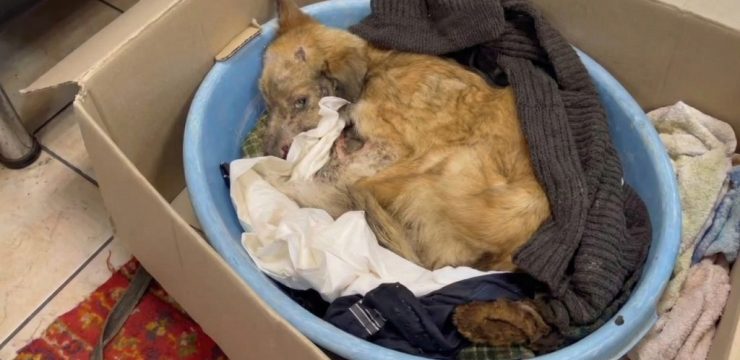
Millie’s challenges were not only emotional. Hidden beneath her timid posture were serious physical problems. Tests revealed that she was positive for heartworm disease, a condition that can slowly damage the heart and lungs if untreated. She also suffered from arthritis in her back and knees, bringing constant discomfort that likely deepened her withdrawal.
Pain and fear often grow together, each strengthening the other in a difficult cycle. Careful treatment began under veterinary supervision. Medication addressed the heartworm infection, and supportive care helped manage the arthritis that troubled her joints. Yet medicine alone could not repair the deeper wounds left by abandonment.
Emotional healing requires something far less visible than pills or procedures. It asks for time, calm consistency, and genuine kindness. Millie’s rescuer understood this truth. Instead of pushing for interaction, she allowed Millie to feel almost invisible. A crate became her sanctuary rather than a prison. No one dragged her out.
Meals were set gently nearby. Soft voices filled the room while daily life continued at a peaceful pace around her. Nothing rushed her. Nothing demanded bravery before she was ready. Over days and weeks she quietly observed. From the safety of her crate she began studying the people who cared for her.
Trust rarely returns through grand gestures. It grows quietly inside small ordinary moments. The absence of harm slowly becomes its own reassurance. Little by little Millie’s trembling softened. She still kept her distance, yet her breathing steadied. When her rescuer spoke, Millie listened carefully from her corner.
Then one quiet day something remarkable happened. Without coaxing or pressure, Millie stepped out of her crate on her own. First came a cautious paw touching the floor. Then another followed. Her body remained stiff and uncertain, but she kept moving forward.
That small step meant far more than a change in location. It carried courage. It revealed that somewhere deep inside her frightened heart a quiet spark of hope had begun to rise again.
Soon afterward came another moment so subtle it could easily have been missed. Millie’s tail moved. Not wildly and not with the carefree excitement of a puppy, but gently. A slow, careful wag. For a dog who once trembled in every corner, that small motion carried enormous meaning.
Healing rarely arrives in dramatic bursts. Instead it unfolds through quiet progress. A lifted head. A longer glance. A body that no longer shrinks at every sound. Millie slowly allowed gentle touch. She sat a little closer to the person who had saved her.
Her eyes, once clouded with fear, began to show curiosity again. The world no longer looked like a place she needed to hide from forever. With proper treatment her physical pain eased. With steady compassion her emotional scars slowly began to mend.
Many people assume older shelter dogs cannot truly change. Millie gently proves otherwise. At seven years old she had already experienced deep loss and confusion. Yet resilience can live quietly inside even the most frightened hearts. Given safety, patience, and consistent kindness, a wounded animal can rediscover trust step by step. Millie did not need to become a different dog to deserve life and care.
What saved Millie was not a miracle cure or sudden transformation. It was patience offered day after day. It was a rescuer willing to meet her exactly where she was, without rushing her fragile progress. In time the trembling corners of her past faded behind her. In their place stood a quieter but braver dog whose spirit slowly began to shine again. Millie’s journey reminds us that compassion can restore a life that once seemed almost lost, and that steady love can heal even the deepest wounds of abandonment given time patience and unwavering kindness.