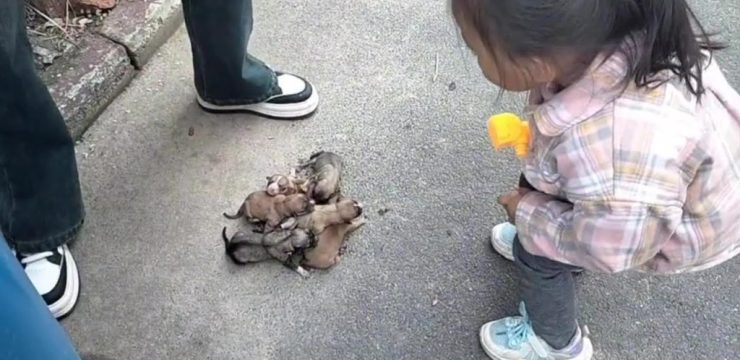
On a bitter winter afternoon, when the wind seemed determined to cut through anything in its path, a small stray dog was found lying outside an abandoned company building. The lot around him was empty and silent, the pavement cracked and rimmed with frost. He was too exhausted to stand and barely strong enough to lift his head. At first glance, he didn’t even look alive. He resembled a discarded bundle of tangled fur, something the world had carelessly left behind.
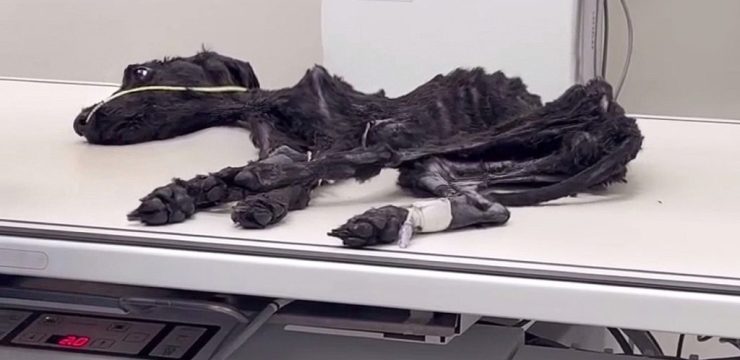
As rescuers drew closer, they saw that his small body was hidden beneath an enormous, matted coat thick with mud and debris. The fur was so heavy it dragged him down, like a weight he had been forced to carry for far too long. It wasn’t simply long hair. It had twisted and hardened into dense clumps that pulled painfully at his skin. Every slight movement seemed to cost him tremendous effort. Walking must have felt nearly impossible. In truth, he was trapped inside his own neglected coat—cold, hungry, and utterly worn down.

The team approached him slowly, mindful that a life on the streets teaches caution. His eyes tracked their every move. He had likely survived by instinct alone, learning to expect disappointment or danger rather than kindness. Instead of rushing toward him, the rescuers knelt at a distance and spoke in soft, steady tones. They offered food, placing it gently within reach. They gave him time.
Hunger, in the end, overcame fear. With fragile determination, he edged forward, drawn by the scent of something warm to eat. It was a small step, but it was also a brave one. Bit by bit, as the rescuers remained patient and calm, he allowed them closer. Trust does not come easily to a stray who has known only uncertainty. Yet compassion speaks a language that even the most guarded heart can understand. When they finally lifted him into their vehicle, he did not resist. That quiet acceptance marked the beginning of a long journey toward medical care—and toward a life he could not yet imagine.
At the veterinary clinic, the full reality of his condition became heartbreakingly clear. What appeared to be an overgrown coat was, in fact, an astonishing eleven kilograms—nearly twenty-four pounds—of compacted fur, dirt, and debris. For a dog of his size, that burden was overwhelming. No wonder he had struggled to move or even stand for long. The matting had to be removed carefully, a slow process requiring patience and skilled hands.
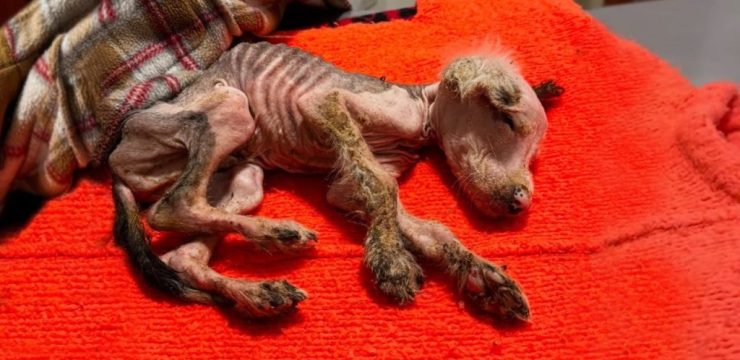
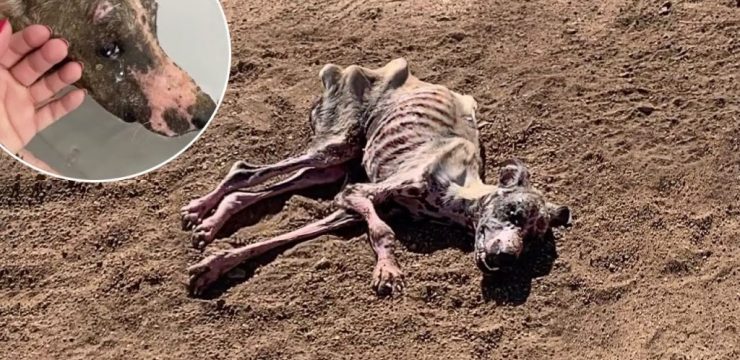
As the clumps were shaved away, the fragile dog underneath gradually emerged. Beneath the heavy layers, his body was thin and undernourished, his ribs faintly visible under irritated, inflamed skin. Areas that had been sealed beneath grime showed clear signs of discomfort. Small insects had taken refuge in the dense coat. He was running a fever, his immune system strained from prolonged neglect and exposure to freezing temperatures.
Yet even in that vulnerable state, there was something steady in his eyes. Once freed from the crushing weight of his fur, he seemed lighter almost instantly, as though he could finally draw a full breath. The physical transformation was immediate, but emotional healing would take time. The veterinarian prescribed medication to treat skin inflammation and infection, along with careful monitoring to address his fever and overall weakness. A warm coat was placed around his freshly shaved body to shield him from the cold. For the first time in many months, perhaps longer, he felt true warmth and safety.
Proper nutrition became essential to his recovery. He was introduced to a high-protein diet designed to rebuild strength and restore healthy body weight. Consistency and gentle care worked wonders. Within a single week, he gained four kilograms. The difference was not only visible in his body but also in his expression. The dull, guarded look that once defined him began to soften. His tail wagged hesitantly at first, then with growing confidence. Each small sign of trust felt like a victory.
One of the most touching chapters of his healing came through companionship. The rescuers had another dog, calm and steady, who seemed to sense exactly what the newcomer needed. The resident dog approached him without pressure, offering quiet company rather than overwhelming excitement. What began as cautious curiosity blossomed into a gentle friendship. They lay side by side in the yard, explored together, and shared meals peacefully. Through that bond, the once-forgotten stray rediscovered something that hardship had nearly erased—his playful spirit.
As weeks turned into months, the fragile creature found outside the abandoned building grew stronger with each passing day. His skin healed under attentive care. Soft new fur began to grow, replacing the suffocating mat that had once defined his appearance. The inflammation subsided, his temperature stabilized, and his appetite returned with enthusiasm. Movement, once strained and labored, became easy and joyful.
Today, he bears little resemblance to the exhausted dog discovered in the freezing cold. He runs freely, unburdened and energetic. His coat is clean and healthy. More importantly, he is no longer alone. He has become a cherished member of a family that sees him not for the hardship he endured, but for the gentle soul he has always been.
His days are now filled with simple pleasures—morning walks beneath open skies, warm blankets at night, and the steady presence of caring hands. Gratitude shows itself in quiet gestures: a soft nudge against a leg, a contented sigh as he settles down to rest. Where there was once abandonment, there is belonging. Where there was once isolation, there is companionship.
This rescue reminds us that the heaviest burdens are often the ones we cannot see at first glance. Beneath layers of dirt, fear, and neglect, resilience can still be waiting. With patience, skilled care, and unwavering compassion, a life that seems beyond saving can be restored.
For anyone who has ever wondered whether a single act of kindness truly makes a difference, his story offers a clear and powerful answer. It does. And sometimes, it changes everything.