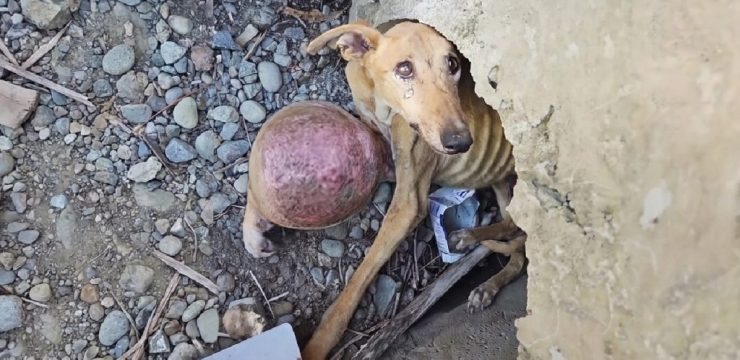
Socorro was once nothing more than a quiet shadow in a backyard, the kind of presence people stop noticing after a while. While the family’s other dog slept inside the house—warm, dry, and protected—Socorro stayed outside, chained in the same spot day after day. He faced cold wind, hard rain, and long nights with no comfort except the small patch of ground beneath his paws. His world was made of silence and waiting, and the waiting never seemed to end.

No one truly understood what he was living through until help finally arrived.
When rescuers came to the property with local police, they expected to find neglect. What they found was far worse than they imagined. Socorro was completely blind. He had been living in darkness for years, unable to see the yard, the sky, or the faces of the people who passed him by. He had no way to understand why he was alone, no way to search for comfort, no way to escape the loneliness. That chain wasn’t only holding his body in place—it was holding his entire life still, trapping him in a routine of suffering and isolation.
And yet, even after everything, Socorro did not respond with anger.
He didn’t snarl or lash out. He didn’t fight the people who approached him. Instead, he trembled quietly, as if his body couldn’t decide whether this moment was real. It wasn’t the kind of shaking that comes from aggression. It felt like the shaking of an animal who has endured too much and is trying to believe that something might finally change. His body showed the evidence of neglect—thin, worn down, and tired—but his spirit, somehow, still carried a fragile spark. Deep inside, it seemed he had been waiting for someone to notice him, to recognize that he mattered.
When the chain was removed, Socorro took his first steps into freedom with hesitation. His legs wobbled, unsteady from years of being confined to only a few feet of movement. He moved slowly, feeling his way forward, unsure of what was ahead. But even in that uncertainty, there was something powerful: he was no longer trapped. The ground beneath him was soft, the air smelled different, and for the first time in a long time, the world did not feel like a cage.
Soon after, Socorro was given a warm bath. To some people, a bath might seem like a simple routine, something ordinary. But for him, it was something much deeper. It was gentle hands that didn’t cause pain. It was warm water washing away layers of dirt and discomfort that had built up over years. It was the first time in a long time that he was treated with patience instead of neglect. In that quiet moment, healing began—not just on his skin, but in his heart.
Those first few days after rescue were filled with small discoveries that meant everything. Socorro was given soft blankets to rest on, meals that left him full instead of hungry, and a calm space where he could finally breathe. Most importantly, he was given kindness. For the first time in his life, people spoke to him with warmth. He was called by name. He was approached carefully, as if his feelings mattered. He was held with care, not treated like an object left behind in the yard.
Even without sight, Socorro started learning the layout of his new environment. He listened closely, memorizing sounds and patterns. He learned where footsteps usually came from, where voices were located, where the comforting smells of food and clean bedding waited. Each day, he took another step forward, not just physically, but emotionally. Every gentle touch taught him something he had never been allowed to believe before: not all humans ignore, abandon, or forget.
Then came the greatest gift of all—a compassionate woman who opened her home and her heart to him.
She didn’t look at Socorro and see a problem. She didn’t see a dog that was “too damaged” or “too difficult.” She saw a living soul who deserved peace. Her home wasn’t fancy, but it was filled with warmth, routine, and quiet love. For Socorro, that kind of home was more valuable than anything. He had his own bed, his own safe corner, and days that finally made sense. Mornings brought gentle belly rubs. Afternoons offered naps in calm sunlight. Soft music played in the background, and there was always someone nearby to whisper the words he needed most: “You’re safe now.”
With patience and steady care, Socorro began to blossom. He learned the sound of his name and the rhythm of the woman’s steps. He could tell when she was near, and his tail would wag in response, a simple sign of trust that carried so much meaning. He would lean against her legs with a quiet sigh, as if he was finally letting go of years of tension. His eyes remained clouded and unseeing, but there was a new kind of light in him—a light that didn’t come from vision, but from love.
There is something remarkable about animals who survive hard lives. They don’t hold grudges. They don’t demand revenge. They simply want a chance. A chance to feel warmth. A chance to rest without fear. A chance to be treated with dignity. Socorro’s story isn’t only about rescue. It’s about redemption. It’s proof that even the most wounded spirit can find peace when the right person chooses compassion.
In his new life, Socorro found more than safety. He found dignity. He no longer slept on cold ground or woke up to harsh weather. Instead, he curled up on soft cushions, his body finally able to relax. He discovered the simple joy of sniffing flowers in a backyard, of feeling sunshine on his fur, and of hearing a kind voice that truly meant it. His days became filled with quiet happiness: birds singing in the morning, meals that smelled like comfort, blankets that carried the scent of home.
Socorro is no longer just surviving. He is thriving.
And in every careful step he takes, in every peaceful sigh he lets out while resting, there is a message that needs no words at all: love heals.
His story is a reminder of the animals we don’t always see—the ones suffering silently behind fences, hidden from the world. It shows us that kindness doesn’t have to be loud or dramatic. Sometimes, it’s simply showing up. It’s noticing the forgotten. It’s choosing to care when it would be easier to look away.
For anyone who has ever doubted the power of compassion, look no further than Socorro. His journey proves that even after years of darkness, the light of love can still reach the heart. He may never see again with his eyes, but in every other way, Socorro sees clearly now. He knows what it means to be safe. He knows what it means to be loved. And at last, he knows what it means to be home.