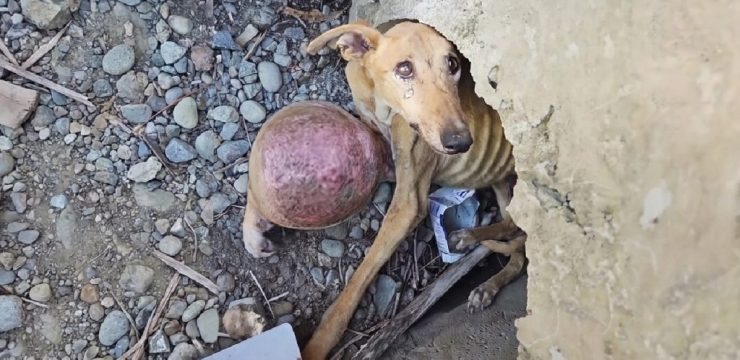
Aurora lay trembling beside a dusty roadside, her small body perfectly still while her wide eyes held a mixture of fear and silent pain. There were no cuts, no bruises, no signs that a vehicle had struck her or that she had fallen. Yet she could not move a single leg. Only her head, her eyes, and the soft flick of her tongue showed that she was still alive. She cried in a faint, weary way, unable to run, play, or even sit upright, left alone in a world that suddenly felt far too big.
When rescuers finally reached her, they were confused by what they saw. Aurora was clean, well cared for, and appeared to have been fed, but all four of her legs were completely lifeless. Local veterinarians ran tests and scans, yet nothing seemed to explain her condition. Her bones were intact, her spine showed no obvious damage, and there was no clear injury. Even when her legs were gently touched, she reacted, which meant she could still feel them, but her body simply would not obey.

As more specialists reviewed her case, the outlook grew darker. Without a clear diagnosis and with no movement in her limbs, some experts began to suggest euthanasia as the most merciful option. They believed it would spare her from a future filled with suffering and helplessness. The rescue team could not accept that. They saw something in Aurora’s eyes, a quiet determination that told them she still wanted to live, and they refused to give up on her.
Their search for answers led them to a seasoned neurologist who had worked with many rare and difficult cases. After carefully studying Aurora’s scans, he noticed something that others had missed. Her spine was straight, her vertebrae properly aligned. The problem, he believed, was not in her back at all but in her brain. This discovery opened a new and uncertain door: brain surgery, a procedure that carried real risks but also real hope.
Aurora was prepared for an operation that came with no promises. No one could say for sure whether she would ever walk again, or even survive the surgery. What they did know was that she was in constant discomfort, and relieving that pain was reason enough to try. With steady hands and careful focus, the surgeon worked to reduce the pressure inside her brain, pressure that was thought to be blocking her ability to move.
When Aurora woke up after the procedure, something had changed. She was calm, no longer restless or distressed. Her legs were still not moving, but the deep, relentless pain that had weighed on her was gone. It was not a miracle cure, yet it was a turning point, a gentle sign that her life could be better than it had been.
From that day forward, her real recovery began. Each morning and evening, her caregivers gently stretched her muscles to keep them from weakening. They spoke to her in soft, encouraging voices, offering treats and affection as they worked. Physical therapy became a daily ritual, not just to help her body, but to rebuild her trust and spirit after so much confusion and fear.
Slowly, almost imperceptibly, changes began to appear. Aurora’s neck grew stronger, allowing her to lift and turn her head more easily. Her eyes followed the people she loved as they moved around her. Then one day, a tiny twitch rippled through one of her hind legs. It was small, but it was real, and it brought tears to everyone watching. It meant her nerves were beginning to wake up again.
Every little step forward became a celebration. When she could hold her head steady for a few seconds longer, when her tail gave a faint wag, when her response to touch grew more certain, each moment felt like a gift. Aurora showed everyone that progress does not always come in big leaps. Sometimes it arrives quietly, one breath, one movement at a time.
Most importantly, she was no longer facing her struggles alone. She had people who believed in her, who did not measure her worth by how fast she could run or how high she could jump. They valued her for the gentle light in her eyes and the courage in her heart. Even though she was not yet chasing balls or exploring fields, she was surrounded by warmth, safety, and love.
Aurora’s story is about more than physical healing. It is a reminder of the strength found in those who are often overlooked or underestimated. It shows what can happen when compassion is chosen over convenience, when patience replaces fear. She never asked for a second chance, yet when it was given, she held onto it with everything she had.
In a world where animals with special needs are sometimes forgotten, Aurora stands as a symbol of quiet perseverance. Her age, her condition, and her limitations do not define her value. What defines her is the gentle courage she shows every day and the way she continues to trust after so much hardship.
For anyone who has ever felt hopeless, her journey offers comfort. Not every battle is won through strength alone. Some are won through patience, kindness, and the simple belief that every life matters. Aurora is still on her path, and no one knows exactly where it will lead, but she is no longer lying alone by the side of the road.